Hydraulic assembly carries extremely high stakes across industrial sectors. A single improper crimp can trigger severe fluid leaks. It can also cause catastrophic equipment failure and immediate safety hazards. The 2026 manufacturing landscape demands stricter tolerances than ever before. Facilities are rapidly shifting toward high-precision micrometers. They also favor faster cycle times and highly accessible battery-operated mobile units. Relying on outdated equipment puts your technicians at risk. It severely hampers daily productivity and limits your operational growth.
We designed this guide to help you navigate modern equipment options. You will receive a vendor-neutral, engineering-focused framework. We will show you how to shortlist potential machines. You can then confidently evaluate and purchase a hydraulic hose crimping machine based strictly on operational realities. We avoid flashy marketing claims. Instead, we focus on what keeps your shop running smoothly and safely.
Key Takeaways
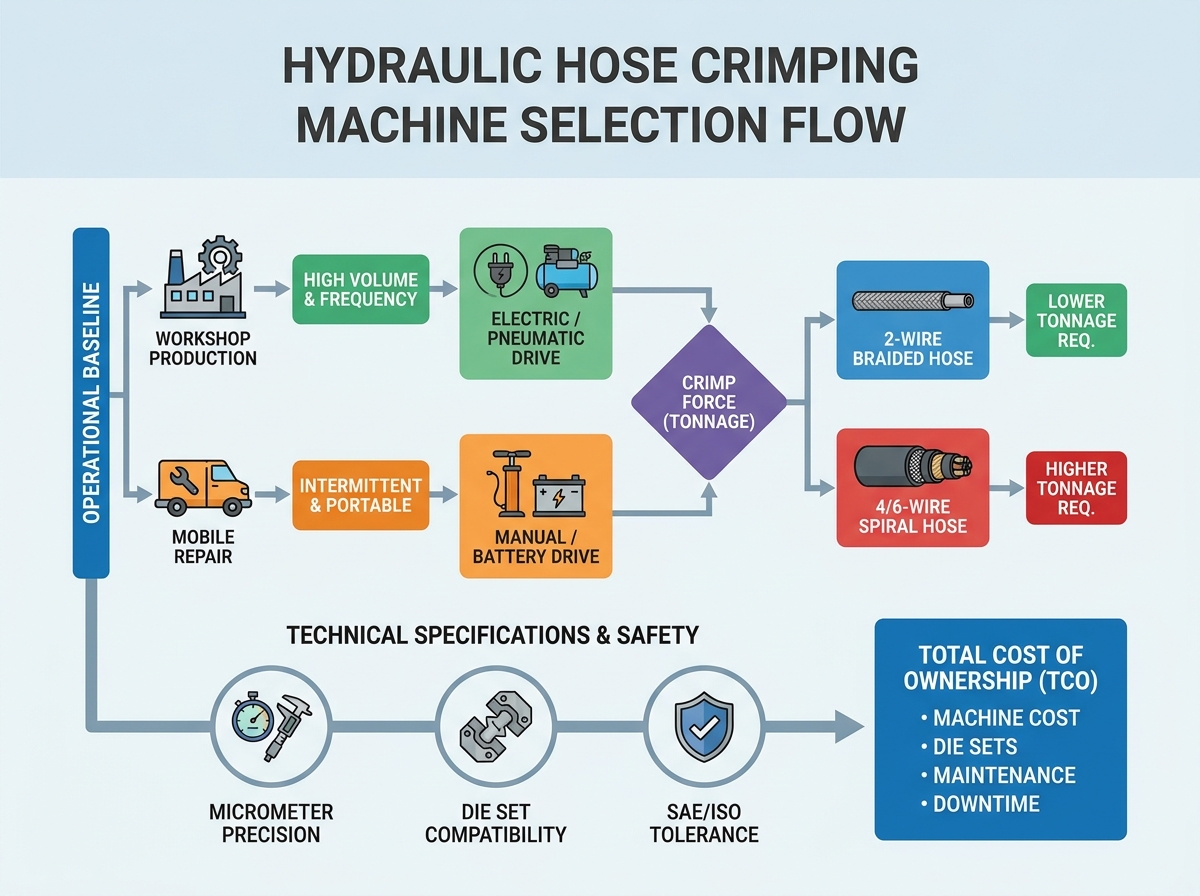
Tonnage Dictates Capability: Selecting crimp force (tonnage) must align with the thickest, highest-pressure hose in your inventory (e.g., 4-wire or 6-wire spiral hoses require significantly higher tonnage than 2-wire braided).
Environment Determines Drive Type: The choice between manual, pneumatic, electric, or battery-operated models depends strictly on whether the primary application is in-field emergency repair or high-volume shop production.
Die Set Compatibility is Crucial: Upfront costs are deceiving; proprietary die sets can inflate the Total Cost of Ownership (TCO) over a 5-year period.
Precision = Safety: Reliable machines must feature micro-dial calibration to ensure compliance with SAE/ISO hose assembly tolerances.
Defining Your Operational Baseline: Workshop vs. Mobile Repair
You must establish a clear operational baseline before evaluating technical specifications. Your daily workflow determines your equipment requirements. A high-volume production facility operates differently than a mobile repair truck. You need to map out your exact use case.
Volume & Frequency: OEM production environments demand continuous operation. These facilities require three-phase electric power to sustain rapid cycle times. You cannot afford slow ram retraction when assembling hundreds of hoses daily. Conversely, intermittent repair tasks rely on entirely different systems. A mobile mechanic generally uses manual pumps or 12V/24V battery systems.
Hose Specifications: You must map out your exact hose construction types. Identify if you process 1SN, 2SN, 4SP, 4SH, or R15 hoses. 1SN and 2SN are braided hoses. They require lower crimping forces. 4SP and R15 are heavily reinforced spiral hoses. They demand massive hydraulic pressure. Always document the maximum internal diameter (ID) your facility currently processes.
Portability Requirements: Service trucks face strict weight limits. They also have tight footprint constraints. You must calculate the available space inside your mobile unit. A dedicated workshop bench offers unlimited space. Workshops easily accommodate heavy, cast-iron production crimpers.
Evaluating Core Drive Mechanisms and Power Sources
The drive mechanism acts as the heart of your crimper. It dictates the speed, portability, and power of the unit. You must align the power source with your working environment. Choosing the wrong drive type leads to immense operator frustration.
Drive Type
Best Application
Key Limitation
Manual/Hand-Pump Hydraulic
Occasional remote field repairs where power is unavailable.
High operator fatigue; inconsistent cycle times; generally limited to 1-inch or 1.25-inch 2-wire hoses.
Pneumatic (Air-Driven) Hydraulic
Shops utilizing existing industrial air compressors seeking an affordable upgrade.
Requires consistent CFM supply; slower ram speed than electric equivalents.
Electric/Mains Hydraulic (110V/220V/3-Phase)
High-volume assembly, handling up to 2-inch to 4-inch multi-spiral hoses.
Zero portability; requires dedicated electrical infrastructure and wiring.
Battery-Operated (Cordless)
Modern mobile hose replacement vans performing field service.
Battery degradation over time; limited crimps per charge on high-pressure 4-wire hoses.
Manual hand-pump units excel in remote forestry or agriculture. They require zero external power. However, operator fatigue sets in quickly. They struggle with large-diameter hoses. Pneumatic models offer a budget-friendly step up. They leverage your existing shop air. You must ensure your compressor delivers adequate CFM.
Electric units dominate professional production shops. A 220V or 3-phase electric motor provides unstoppable force. They breeze through thick multi-spiral hoses. Battery-operated units revolutionized the mobile repair industry. Modern lithium-ion batteries provide excellent power. However, extreme cold weather reduces battery efficiency. You also face a limited number of heavy crimps per charge.
5 Technical Specifications to Scrutinize Before Buying
Marketing brochures often highlight superficial features. You must ignore the hype. Focus entirely on the engineering fundamentals. Scrutinize these five technical specifications to ensure long-term reliability.
Crimp Force (Tonnage): You must calculate a necessary force buffer. Many buyers make a critical error here. They buy a 100-ton press for a fleet running thick 4-spiral hoses. The machine technically works, but the pump runs at maximum capacity. The hydraulic fluid overheats rapidly. The motor eventually burns out. Always buy a machine offering 20% more tonnage than your toughest hose requires.
Max Opening & Die Range: Evaluate the master die opening carefully. You will frequently work on complex angled fittings. A 45-degree or 90-degree flange requires massive clearance. If the die opening is too narrow, you cannot remove the fitting post-crimp. The newly assembled hose gets stuck inside the machine head.
Calibration & Micrometer Precision: Precision prevents catastrophic blowouts. Reliable machines feature visual dial indicators or digital touchscreens. These mechanisms allow micro-adjustments down to fractions of a millimeter. You must hit the exact manufacturer-specified crimp diameters. Guesswork guarantees an eventual fitting failure under high pressure.
Cycle Time: Cycle time measures how fast the cylinder completes one stroke and retracts. Consider the retraction speed of the hydraulic cylinder. A 10-second difference seems minor. However, it matters immensely in a 500-assembly-per-day shop. Slow cycle times destroy profit margins in production environments. Mobile mechanics can safely ignore cycle time metrics.
Build Quality & Cylinder Design: Assess the overall durability of the hydraulic cylinder. Inspect the quality of the internal seals. The head casting must feature extreme rigidity. A weak casting flexes under maximum load. Head flex causes oval crimps instead of perfectly round ones. Look for forged steel components and robust manufacturing techniques.
Safety Standards, Compliance, and Implementation Risks
Hydraulic fluid operates under extreme pressure. A failed hose assembly acts like a dangerous projectile. You must prioritize equipment compliance and operator safety. Poorly designed machines expose your company to massive liability.
SAE and ISO Tolerance Adherence: Your machine must hold incredibly tight tolerances. Global hydraulic assembly safety standards demand absolute precision. SAE J517 and ISO 1436 dictate specific performance criteria. A compliant crimper ensures your assemblies survive severe pressure spikes.
Operator Safety Mechanisms: Never compromise on physical safety features. Look for prominent emergency stop buttons. Guard rails must protect the primary pinch points. Production models often utilize two-hand operation controls. These controls force the operator to keep both hands away from the danger zone during the compression cycle.
Implementation Overhead: Factor in the initial learning curve. Operators need comprehensive guidance. Does the vendor supply proper die-selection charts? Ask about training materials for your technicians. Proper onboarding prevents costly setup mistakes and ruined materials.
Maintenance Realities: Heavy machinery demands routine care. Highlight the necessity of regular greasing. If the machine is not self-lubricating, operators must apply specific grease. Unlubricated dies grind against the master bowl. This causes irreversible wear. You must also schedule regular hydraulic fluid changes and inspect die surfaces for galling.
Investment Quality and Shortlisting Logic
Focusing solely on the initial purchase price is a dangerous strategy. You must evaluate the entire lifespan of the equipment. Cheap machines often hide expensive operational flaws. Smart buyers analyze maintenance logistics, parts availability, and long-term ecosystem costs.
Beware the "cheap machine" trap. Low-cost, unbranded imports flood the market. They seem attractive initially. However, they frequently utilize porous metal castings. Their cylinder seals begin leaking within months. The onboard micrometers lose zero-calibration quickly. A machine losing calibration produces dangerous, unpredictable hose assemblies.
Die set economics heavily influence your operating budget. Standardized dies give you freedom. Proprietary dies lock you into a single-vendor ecosystem. Vendors often inflate the price of proprietary expansion sets. You must calculate the cost of replacing worn dies over several years. Choose systems utilizing widely available, standardized die profiles whenever possible.
Warranty terms and support agreements protect your uptime. Consider the true cost of unexpected downtime. If a cylinder blows, you lose revenue every single hour. Prioritize vendors warehousing spare parts locally. They provide fast turnarounds on cylinder rebuilds. For personalized guidance on building a resilient equipment setup, contact us today.
Filter potential models strictly by max hose capacity and required tonnage.
Filter the remaining options by your available power source (electric vs. battery).
Compare the full package value, including the machine, a full die set, and maintenance kits.
Verify the vendor maintains strong local parts availability and technical support.
Conclusion
A high-quality crimping machine represents a serious capital investment. It directly impacts your operational safety and asset uptime. You cannot afford to cut corners on fundamental engineering. An inadequate machine frustrates your technicians and creates dangerous work environments.
We advise buyers to avoid over-specifying. Do not pay for advanced digital features you will never use in the field. However, never under-specify on critical elements. Always secure adequate tonnage and comprehensive die capacity. A well-sized machine operates smoothly and lasts for decades.
Take immediate action before requesting a formal quote. Audit your current hose inventory thoroughly. Document your exact sizes, pressure ratings, and common fitting types. This inventory data ensures you select the perfect equipment for your specific operational needs.
FAQ
Q: How much crimping force (tonnage) do I need for a 2-inch 4-wire hydraulic hose?
A: You typically need at least 250 to 300 tons of crimping force. The exact requirement depends on the fitting design and the specific hose jacket. Always build in a 20% tonnage buffer. This buffer prevents machine strain during continuous operation and accommodates thicker aftermarket hoses without stalling the motor.
Q: Can I use any brand of dies in my hydraulic hose crimping machine?
A: No. You must use dies designed specifically for your machine model. Proprietary machine tolerances differ widely from generic dies. Mismatched dies will cause uneven crimping. They can easily crush fittings or leave dangerous gaps. Using incorrect dies usually voids your manufacturer warranty immediately.
Q: What is the difference between a micrometer dial and a digital controller?
A: A micrometer dial offers robust, analog reliability. It performs exceptionally well in dirty, dusty environments where touchscreens fail. A digital controller provides programmable preset memory. Digital systems excel in high-volume, multi-operator shops. They reduce human error by automatically loading exact crimp diameters for specific production batches.
Q: How often does a hydraulic crimper need to be calibrated?
A: You should perform a complete machine calibration annually or every 10,000 crimps, whichever comes first. However, operators must spot-check finished assemblies daily. Use digital calipers to verify the final crimp diameter against the manufacturer’s specifications. Daily checks ensure continuous safety and catch minor mechanical drift early.
Handanshi Kangmai Hydraulic Equipment Co., Ltd. is located in the east of Wangzhuang,on the Hanlin expressway. Our main products have 9 series and 50 types which contains hose crimping machine, hose cutting machine,hose skiving machine...