In the unforgiving environment of marine operations, fluid power systems face constant threats. A single hose failure rarely just causes minor delays. It often triggers catastrophic downtime. You might face severe environmental hazards. It also creates critical safety risks for the entire crew. Standard industrial equipment simply cannot survive these extreme conditions. High-salinity air quickly degrades conventional metals. Constant moisture destroys delicate calibration mechanisms inside standard tools. Offshore decision-makers must deploy equipment specifically engineered for harsh maritime realities.
This comprehensive guide breaks down the essential evaluation criteria for your next deployment. We explore how to balance regulatory compliance, rugged durability, and daily operational efficiency. You will learn exactly what differentiates a marine-grade asset from a standard workshop tool. By understanding these nuances, operators can safeguard their vessels. You can prevent catastrophic blowouts and keep critical hydraulic systems running smoothly across the fleet.
Key Takeaways
Marine-grade crimping requires specific anti-corrosion treatments and sealed components to withstand salt spray and constant humidity.
Selecting between portable, pneumatic, and workshop models depends on the primary deployment location (vessel emergency kits vs. shipyard fabrication).
Compliance is non-negotiable; chosen equipment must support assemblies that meet DNV, ABS, and USCG standards.
Total Cost of Ownership (TCO) evaluation must heavily weight global parts availability and calibration retention in extreme environments.
The Business Case: Why Marine Environments Demand Specialized Crimping
A blown hydraulic line on an offshore rig stops drilling operations instantly. Commercial vessels lose steering capabilities during critical maneuvers. They might also lose deck winch controls while loading cargo. The financial impact of hydraulic failure compounds rapidly. Towing costs reach exorbitant levels when engines fail. Environmental fines for oil spills further damage your bottom line. You cannot afford equipment failures when operating hundreds of miles offshore.
Standard machines fail quickly in offshore environments. Saltwater eats through unprotected steel surfaces within weeks. Rusting dies ruin crimp precision. This degradation causes dangerous high-pressure leaks. High humidity degrades internal calibration mechanisms rapidly. Unsealed electrical panels often short out during heavy ocean storms. Using inland industrial tools on a rig guarantees premature failure. Operators need robust solutions built for reality.
A successful maritime deployment looks entirely different. It requires predictable maintenance schedules across all vessels. Operators expect zero blowouts under high operational pressure. The machine must deliver consistent die calibration daily. It must hold precision despite constant vessel vibration. Extreme temperature swings should never affect your final assembly quality. You need equipment built explicitly for these punishing marine realities. Proper investments eliminate unexpected breakdowns entirely.
Types of Hydraulic Hose Crimping Machines for Offshore Use
Marine environments require different tools for different spaces. You must match the equipment type to your primary deployment location. Each category serves a highly specific operational purpose. Understanding these categories prevents dangerous misapplications onboard.
Portable and handheld units work best for emergency onboard repairs. Crews use them heavily in confined spaces. They easily navigate tight deck machinery areas or crowded engine rooms. When evaluating these tools, assess manual versus battery-operated options carefully. The weight-to-power ratio serves as your primary constraint here. Heavy units fatigue operators quickly during emergency nighttime repairs. We recommend selecting lightweight models featuring reinforced carrying handles.
Pneumatic or air-driven tools dominate hazardous locations. Oil rigs and tankers require these specific HazLoc designs. They are absolutely essential for ATEX or spark-free zones. Electrical equipment poses severe explosion risks near drill floors. Flammable gases accumulate quickly in these areas. Air-driven units eliminate this danger entirely. They provide robust pressing force without electrical ignition hazards. This choice guarantees crew safety during critical operations.
Heavy-duty workshop units belong in large shipyards. You will also find them stationed in offshore supply bases. Dedicated rig maintenance shops rely on them daily. These units handle high-volume production schedules easily. They powerfully compress heavy high-pressure multi-spiral hoses. Focus your evaluation on overall cycle times. You should also prioritize automated calibration features for processing large batches efficiently.
Equipment Category
Primary Deployment Area
Best Use Case
Key Limitation
Portable / Handheld
Engine rooms, cramped decks
Emergency onboard hose repairs
Lower maximum pressing force
Pneumatic / Air-Driven
HazLoc / ATEX spark-free zones
Operations near flammable gases
Requires dedicated air supply
Heavy-Duty Workshop
Shipyards, supply bases
High-volume multi-spiral assemblies
Lacks onboard mobility
Core Evaluation Criteria for Marine-Grade Crimpers
Choosing the right hydraulic hose crimping machine requires strict technical scrutiny. You must evaluate internal components alongside external durability. A shiny exterior means nothing if the internal pump fails under pressure.
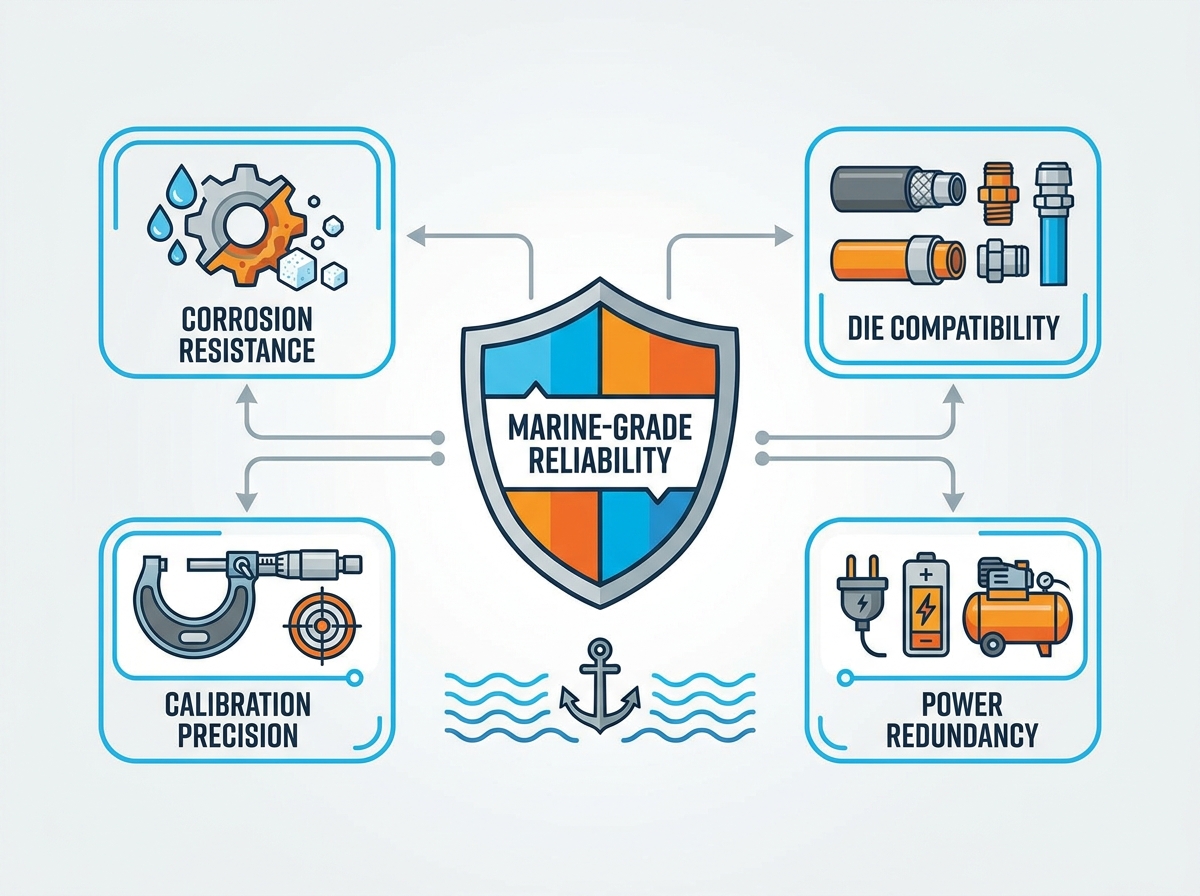
Corrosion resistance dictates the lifespan of your equipment. Look strictly for 316 stainless steel components. Marine-grade epoxy coatings protect the main cylinder housing. Weather-sealed control panels block moisture intrusion effectively. A standard paint job chips and rusts within months at sea. Demand specialized protective coatings from your manufacturer. Unprotected tools become safety hazards quickly.
Die compatibility directly affects your daily repair capabilities. The machine must accommodate heavy-duty marine hoses perfectly. SAE 100R15 standards demand massive compression force. High-pressure multi-spiral hoses require specific die profiles. You must also account for non-standard fittings. Maritime hydraulics often utilize specialized flange connections. Ensure your die sets cover these unique requirements comprehensively.
Here are the core elements you must verify before deployment:
Stainless steel protective housing over primary cylinders to prevent rust.
Sealed micrometer dials to block saltwater intrusion entirely.
Vibration-resistant mounts to maintain calibration during rough transit.
Marine-grade hydraulic fluid compatibility for internal pumps.
Heavy-duty transport cases featuring waterproof O-ring seals.
Calibration precision separates reliable tools from dangerous ones. Evaluate how the unit maintains micrometer accuracy over time. Extreme temperature fluctuations expand and contract metal components constantly. Continuous maritime transit vibrations loosen standard fittings. Your equipment must hold its zero-point despite these harsh physical realities. Substandard precision leads directly to blown fittings.
Power source redundancy keeps you operational during vessel blackouts. Assess voltage compatibility for all electrically powered units carefully. Vessel generators often produce fluctuating power loads. Built-in surge protection prevents expensive motherboard damage. Dual-voltage capabilities offer immense flexibility across different ships. You never want a voltage mismatch halting critical repairs.
Compliance, Safety, and Implementation Risks
Marine regulations leave no room for guesswork or assumptions. Supporting certifications protect your fleet from massive legal liability. The tool must reliably produce passing hose assemblies every time. These assemblies face stringent maritime classification societies constantly. DNV GL, ABS, and Lloyd's Register enforce rigorous structural standards. Your equipment must deliver the exact compression required by these governing bodies.
Operator safety remains paramount in confined maritime spaces. Rolling seas create highly unstable working environments. Evaluate all machine safety guards carefully before purchasing. Emergency stop buttons need absolute accessibility from multiple angles. Ergonomic design prevents muscle fatigue during long repair shifts. A well-designed tool keeps the operator safe when the deck pitches violently.
Implementation brings its own set of operational realities onboard. Rotating maritime crews present a significant training risk. Lack of standard training often leads to improper crimps. You must mitigate this risk through smart equipment selection. Choose intuitive interfaces featuring simple visual cues. Utilize pre-set die profiles whenever possible. Error-proofing mechanisms like go/no-go gauges prevent bad assemblies reaching the deck.
Maintenance dictates your long-term success offshore. Corrosive environments demand relentless and documented upkeep. You must outline a strict lubrication schedule for your crew.
Follow this standardized maintenance sequence for offshore deployments:
Wipe down all die sets using approved anti-corrosive solvents after every shift.
Apply marine-grade lithium grease to the master dies weekly.
Verify the micrometer zero-point using a certified calibration gauge monthly.
Inspect electrical panel seals for salt accumulation or moisture degradation quarterly.
Perform a full system flush of the internal hydraulic fluid annually.
Shortlisting Logic: How to Choose the Right Machine for Your Fleet
Strategic procurement requires matching equipment directly to operational realities. You must weigh volume capabilities against physical agility. Low-volume needs favor specific lightweight tools. High-urgency situations demand portable pneumatic units. You can carry them directly to the broken deck winch immediately. High-volume preventative maintenance requires a different approach entirely. Benchtop models serve this purpose perfectly in the shipyard. Map your choice directly to your daily operational model.
Vendor footprint often decides your long-term success. Assess the global support network of your chosen manufacturer rigorously. Finding a replacement hydraulic hose crimping machine part in Singapore matters immensely. You might need calibration tools sourced quickly in Rotterdam next month. Major international ports must carry your required spares. Extensive lead times leave your valuable vessels stranded. Choose partners boasting robust global distribution networks.
Your procurement strategy should prioritize true supply chain resilience. An isolated breakdown off the coast of Brazil requires rapid intervention. If the manufacturer lacks regional service centers, you lose money daily. Prioritize brands offering immediate technical support across multiple global time zones. Quick technical responses prevent minor issues from becoming major delays. Do your research thoroughly before signing any purchase orders.
Conclusion
Industry leaders no longer view a hydraulic hose crimper as just a generic tool. It stands as a critical maritime safety asset. Proper equipment prevents catastrophic blowouts during heavy lifting. It keeps your crew safe during high-pressure drilling operations. Relying on standard industrial models offshore guarantees mechanical failure. You must demand better engineering for your fleet.
Over-specifying for corrosion resistance is a financially sound strategy. Demanding rigorous precision compliance prevents massive offshore downtime. High-quality marine-grade equipment pays for itself during its first major storm. You secure operational continuity across your entire organization.
Take immediate action before finalizing your offshore procurement. Advise buyers to request comprehensive salt-spray test data. Demand verifiable compliance documentation showing strict precision tolerances. Ask vendors for realistic cycle-life estimates in highly saline environments. Rigorous vetting today ensures flawless fluid power performance tomorrow.
FAQ
Q: Can standard industrial crimpers be used on offshore vessels?
A: No. Standard industrial machines degrade rapidly in offshore environments. They lack essential anti-corrosion treatments entirely. Salt spray quickly rusts unprotected dies. High humidity destroys internal calibration mechanisms. This degradation leads to inaccurate crimps. Inaccurate assemblies pose severe blowout risks under high pressure. You must use specialized marine-grade equipment.
Q: What power source is best for hazardous offshore environments?
A: Pneumatic or air-driven models are essential for hazardous locations. Oil rigs and tankers feature strict ATEX or spark-free zones. Electrical equipment poses extreme explosion risks in these areas. Air-driven tools provide necessary compression force without generating electrical arcs. They ensure complete compliance with global safety regulations.
Q: How often should marine-deployed crimping machines be calibrated?
A: Marine equipment requires more frequent calibration than inland tools. Industry best practices recommend verifying calibration monthly. Extreme temperature swings and continuous vessel vibration alter zero-points rapidly. Use certified go/no-go gauges regularly. Follow ISO standards specific to fluid power systems to maintain assembly integrity.
Q: Do crimping machines come with DNV or ABS certifications?
A: The machines themselves do not carry these specific certifications. DNV and ABS certify the final hose assemblies. However, the machine must possess exceptional precision capabilities. It must consistently produce crimps meeting those strict assembly standards. Always verify the equipment can handle certified marine-grade hose specifications.
Handanshi Kangmai Hydraulic Equipment Co., Ltd. is located in the east of Wangzhuang,on the Hanlin expressway. Our main products have 9 series and 50 types which contains hose crimping machine, hose cutting machine,hose skiving machine...