China currently dominates the global export market for hydraulic hose crimping equipment. This manufacturing concentration offers massive cost advantages for international procurement teams. However, navigating this sourcing landscape introduces a unique set of challenges. The manufacturing sector here remains heavily fragmented. It mixes elite tier-one manufacturers alongside low-quality assemblers and pure trading companies. This reality establishes a major core risk for global buyers. Choosing the wrong vendor can severely disrupt your production line. Procuring substandard equipment leads directly to severe operational consequences. You risk hydraulic leaks, premature hose failures, and critical safety hazards. This article provides procurement managers and workshop owners a verifiable, evidence-based evaluation framework. You will learn how to bypass superficial marketing claims easily. We will show you exactly how to evaluate and shortlist a reliable hose crimping machine supplier China. Ultimately, you will gain the insights needed to secure robust equipment. This knowledge guarantees consistent workshop performance.
Key Takeaways
Supplier Verification: Distinguishing genuine manufacturers from trading companies is the most critical first step to ensuring competitive pricing and reliable technical support.
Component Scrutiny: Long-term machine reliability depends entirely on the origin of core hydraulic components (pumps, valves) and the metallurgical hardness of the crimping dies.
Proof of Performance: Always mandate unedited, timestamped sample crimping videos using your specific hose specifications before finalizing an order.
The Reality of Sourcing a Hose Crimping Machine Supplier in China
Sourcing industrial machinery overseas always balances capital expenditure reduction against operational downtime risks. You want highly competitive pricing. Yet, you simply cannot afford unexpected machinery failures. A failed crimp causes severe hydraulic leaks. It triggers catastrophic equipment failure. It also introduces critical fluid injection safety hazards to your workshop environment. These risks make proper vendor selection absolutely paramount.
We can segment the Chinese supplier market into three distinct tiers. First, we have premium manufacturers. These companies focus heavily on international exports. They maintain robust research and development departments. Second, we find standard volume assemblers. They offer cost-effective units suitable for basic, low-volume workshops. Third, we encounter pure trading companies. These entities white-label products and apply steep markups. They also provide extremely limited post-sale technical support.
Defining a successful procurement outcome goes far beyond simply receiving a functioning unit. True success means acquiring a machine hitting exact tolerance requirements consistently. The equipment must match your local electrical grids perfectly. You should never need dangerous aftermarket transformers. Furthermore, a successful purchase includes a transparent, reliable pipeline for replacement dies. Understanding these fundamentals helps you navigate initial supplier negotiations effectively.
How to Verify Genuine Manufacturers vs. Trading Companies
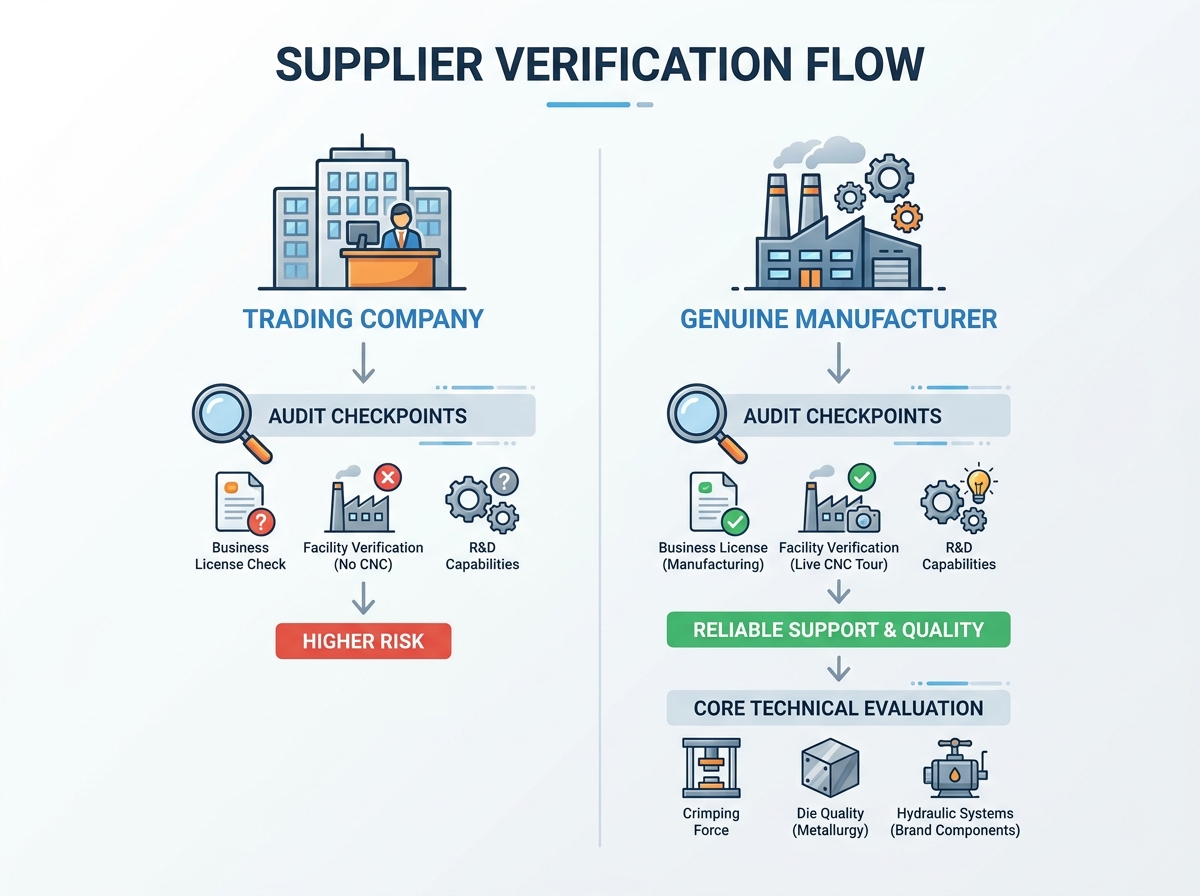
Many online supplier profiles project a convincing factory illusion. They claim to operate as large-scale manufacturers. In reality, they operate simple trading desks from commercial offices. They outsource actual machine production to the lowest bidding assembly workshop. This disconnect destroys quality control. It also inflates your purchase price unnecessarily.
You must perform strict audit checkpoints to bypass this facade. First, conduct a thorough business license check. Request their official Chinese business registration. Look closely for specific manufacturing keywords. Ensure words like "manufacturing" or "production" appear in their registered business scope. If the license only lists "sales" or "trading," you are dealing directly with a middleman.
Next, demand rigorous facility verification. Ask the sales representative for a live video tour. Specifically, request to see their CNC machining center. You want to see exactly where dies are actively cut and hardened. Do not settle for a tour showing only the final paint and assembly line. Trading companies often stage these assembly areas to look authentic.
Finally, evaluate their true research and development capabilities. A genuine manufacturer offers robust OEM and ODM customization. They can design custom die sets easily. Ask them to design a profile for non-standard industrial hoses. If they refuse complex customization requests, they likely lack in-house engineering capabilities.
Core Technical Evaluation Dimensions for Crimping Equipment
Evaluate crimping force alongside actual hose capacity. Do not rely solely on generalized tonnage claims. A machine boasting 500 tons might still fail on heavy-duty multi-spiral applications. Always evaluate the equipment capacity against your specific wire-braid requirements. For example, verify its ability to handle 2SN, 4SP, or 6SP hoses up to two inches.
Die quality and metallurgy require your close scrutiny. Assess the raw material and the heat-treatment process. Reputable factories use high-grade materials like Cr12MoV steel. Soft dies will deform quickly under high-volume industrial use. Deformed dies ruin your crimping precision and waste expensive hydraulic fittings.
Demand full transparency regarding internal hydraulic systems and electrics. Ask direct questions about the internal components. Are they using generic, unbranded pumps? Look for recognized international brands powering their directional valves and motors. Reliable components ensure consistent hydraulic pressure during repeated daily cycles.
Precision and control mechanisms also differentiate machine grades. Distinguish carefully between manual micrometer dials and advanced digital control panels. CNC touchscreens offer superior repeatability. You must factor in the required accuracy for your specific workshop environment.
Technical Evaluation Matrix
Evaluation Dimension
Standard Requirement
Premium Manufacturer Standard
Hose Capacity
2SN / 4SP up to 1 inch
6SP multi-spiral up to 2+ inches
Die Metallurgy
Standard carbon steel
Cr12MoV steel (Heat-treated)
Hydraulic Components
Generic domestic brands
Recognized international valves/pumps
Control System
Manual micrometer dial
Digital/CNC touchscreen control
Navigating Export Compliance, CE/ISO Certifications, and Logistics
Superficial compliance plagues the overseas machinery market. Many suppliers digitally alter certificates. You must prioritize independent certificate authentication. Verify CE certificates directly through European issuing body databases. Validate ISO9001:2015 credentials by checking the registrar's official online portal. Manual verification protects your investment from customs seizures.
Electrical grid matching represents another critical procurement step. You must stipulate exact electrical specifications in the final contract. Clarify the exact voltage and phase requirements. Specify whether you need 220V single-phase or 380V 3-phase power. Clearly state if your local grid runs on 50Hz or 60Hz. Mismatched frequencies cause motor overheating. Clarifying this avoids expensive local electrical modifications later.
Do not overlook international packaging standards. Industrial machinery is heavy and highly sensitive to transit conditions. Specify the absolute need for fumigated wooden crates. Ensure these crates remain suitable for LCL (Less than Container Load) sea freight. Proper internal blocking and moisture barriers prevent corrosion. Secure packaging prevents transit recalibration caused by rough port handling.
Assessing Post-Sale Support and Implementation Realities
The after-sales gap presents a massive hurdle for international buyers. Shipping a heavy 250kg machine back to China for a warranty repair remains economically unviable. You need guaranteed local solutions for overseas machinery problems. A supplier's support infrastructure defines their true value.
Check spare parts availability before wiring any initial deposit. A proactive supplier includes a comprehensive standard maintenance kit in the initial shipment. This kit should contain replacement seals, relays, and quick-wear components. Having these exact parts on hand prevents immediate operational downtime.
Evaluate their technical troubleshooting infrastructure carefully. Ask how they handle complex engineering queries remotely. Consider these specific support checkpoints:
Do they provide clear, native-English operating manuals?
Are step-by-step setup videos readily available online?
Do they offer responsive engineering support via video messaging applications?
Does their technical engineering team overlap with your local time zone?
If you encounter difficulties replacing specific machine parts, you can always contact us for professional technical guidance.
Shortlisting Logic and Finalizing the RFQ
Always demand a rigorous proof-of-concept test before committing. Send your exact hose and fitting specifications to your shortlisted suppliers. Instruct them to perform a live video demonstration. If a live video proves impossible, demand an unedited, timestamped video. The video must show their machine crimping your specific configuration flawlessly. This prevents suppliers from reusing old marketing videos.
Structuring the RFQ (Request for Quote) correctly secures your negotiating leverage. A vague request leads directly to hidden charges and delayed shipments. A professional RFQ standardizes vendor responses. It allows you to compare quotes accurately.
Include these crucial items in your final RFQ document:
Pricing Terms: Clearly define FOB or CIF pricing structures to understand freight responsibilities.
Lead Times: Establish strict deadlines for manufacturing completion and port delivery.
Component Lists: Request a documented list of all hydraulic and electrical brands used.
Warranty Terms: Outline conditions specifically covering international parts replacement via express air freight.
Payment Terms: Negotiate safe financial structures, such as a 30% T/T deposit and 70% against the final Bill of Lading.
Conclusion
Evaluating a hydraulic machinery vendor in China requires looking well past the lowest unit price. You must dig deeper into the factory's actual manufacturing capabilities. Long-term profitability relies entirely on rigorous vendor vetting. Component transparency and verifiable after-sales infrastructure matter far more than initial discount offers.
To ensure procurement success, focus on these final takeaways:
Always verify manufacturing capabilities through live facility tours and business license checks.
Demand premium materials for your crimping dies to ensure long-term durability.
Verify CE and ISO certificates independently to avoid customs delays.
Secure a localized maintenance kit in your initial shipment.
Take action today by formulating your exact technical requirements. Document your specific hose types, daily production volume, and local voltage needs clearly. Next, begin reaching out to verified manufacturers. Request a detailed specification sheet and a custom video demonstration to validate their marketing claims.
FAQ
Q: What is the standard lead time when ordering a hydraulic hose crimper from China?
A: Typically, expect 7 to 15 days for standard models. Customized or CNC-controlled units generally take 20 to 30 days to manufacture. These production timeframes strictly exclude sea freight transit time, which varies by your port destination.
Q: Can Chinese suppliers provide custom dies for specialized industrial applications?
A: Yes. Genuine manufacturers possessing in-house CNC capabilities can machine custom die profiles easily. They can produce specific dies for wire rope, steel pipes, or non-standard fittings based directly on your provided technical drawings.
Q: How do I handle warranty claims if the machine's hydraulic pump fails?
A: Reputable suppliers will ship replacement parts via DHL or FedEx under standard warranty terms. You must ensure your contract explicitly specifies this. The supplier must cover express shipping costs for defective critical components during the active warranty period.
Handanshi Kangmai Hydraulic Equipment Co., Ltd. is located in the east of Wangzhuang,on the Hanlin expressway. Our main products have 9 series and 50 types which contains hose crimping machine, hose cutting machine,hose skiving machine...