
Views: 0 Author: Site Editor Publish Time: 2026-06-29 Origin: Site


Auto repair shops face frustrating operational bottlenecks daily. Repairing complex fluid systems often requires specialized parts. Waiting on external vendors for custom hydraulic, A/C, or air hoses ties up valuable repair bays. It also significantly delays vehicle turnaround times for your waiting customers. Transitioning to in-house hose fabrication requires careful strategic planning to ensure success. Shop owners must balance upfront capital investments and ongoing inventory management against massive gains in labor efficiency. Achieving increased profit margins makes this operational shift highly attractive for growing automotive businesses.
This comprehensive guide evaluates various equipment types and specific facility requirements for auto repair shops. We will explore how to select the right machinery for your daily operational needs. You will learn how to safely manage fitting inventories and prevent vendor lock-in. Finally, we will help you make an informed decision to maximize shop productivity without overspending.
Bringing hose fabrication in-house typically achieves ROI through reduced bay downtime rather than the direct profit margin on the hoses themselves.
Selecting between portable, benchtop, air-powered, or hydraulic machines depends entirely on your shop's split between mobile service and heavy-duty in-shop repairs.
The true cost of ownership is rarely the machine; it is the necessary inventory of brand-specific dies, fittings, and bulk hoses.
Mixing and matching hose and fitting brands compromises safety and liability; standardizing your ecosystem is a mandatory first step.
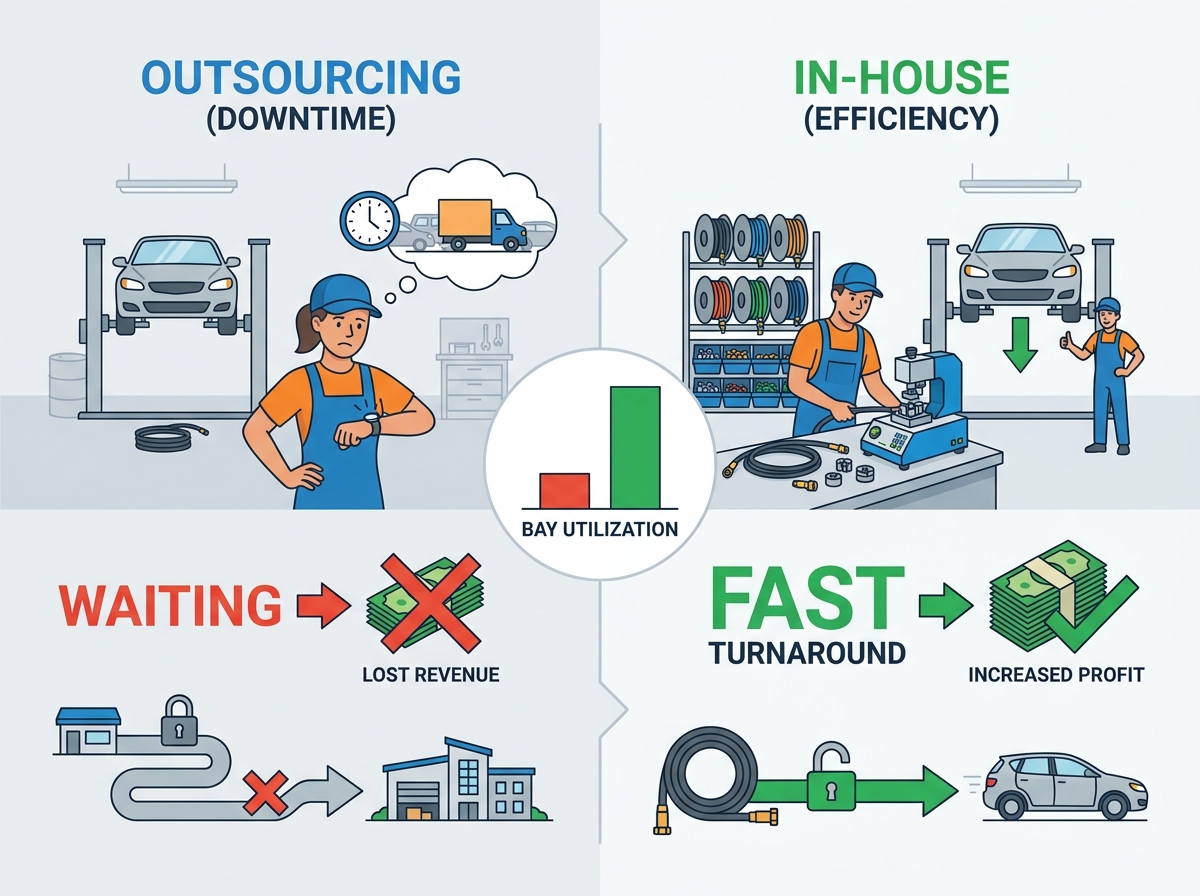
Shop owners often underestimate the true cost of outsourcing hose repairs. Contrast the daily reality of waiting for a local supplier. A technician uninstalls a broken power steering line from a customer vehicle. They drive across town to a specialty hydraulic shop. Heavy traffic adds an hour to the trip. Meanwhile, the original repair bay remains occupied by an immovable vehicle. Your vehicle lifts cannot accept new profitable jobs. The shop loses valuable billable hours rapidly.
Compare this frustrating scenario to in-house fabrication. A technician uses a shop-owned hose crimping machine right on the workbench. The entire fabrication process takes only five minutes. The technician installs the new assembly immediately. The vehicle leaves the repair bay quickly. You restore facility flow and keep your technicians actively turning wrenches.
Business managers must analyze monthly repair volumes carefully. A standard fabrication machine requires an initial capital investment between $2,000 and $5,000. You should closely track your monthly external hose expenditures. Outline the exact volume of hose replacements required to justify this expense. If you spend $500 monthly on outsourced hoses, a $3,000 machine pays for itself in six months. Calculate the hidden operational savings too. Recovered billable hours accelerate your return on investment dramatically. Once you cross the break-even point, every in-house assembly generates pure profit for the shop.
Buying finished assemblies involves paying massive retail markups. External vendors charge you for their labor, materials, and facility overhead. In-house fabrication flips this financial dynamic entirely. You transition to purchasing bulk hoses and raw connectors at wholesale pricing. Your direct material costs drop significantly. You capture the lucrative labor margin previously surrendered to external suppliers. We highly recommend auditing your vendor invoices. You will discover exactly how much profit leaves your shop every week.
Benchtop crimpers require dedicated and stable workbench space. You must secure them properly to prevent dangerous shifting during operation. They require highly stable power delivery systems. Most fixed auto shops utilize standard 110V or 220V electrical circuits. Ensure organized physical proximity to your fitting storage bins. Technicians need quick, ergonomic access to various connectors.
These robust machines excel in overall production capacity. They represent the best choice for shops handling heavy-duty commercial truck repairs. They easily compress thick, steel-braided power steering lines. High-volume batch runs become remarkably simple. Fixed machines deliver the highest peak pressure ratings available.
Portable units serve an entirely different operational use case. They are absolutely ideal for mobile mechanic fleets. Roadside heavy-equipment repair teams rely on them daily. Fixed shops facing severe physical space constraints also benefit from compact designs. You can store them in a cabinet when not in use.
However, mobile equipment introduces specific engineering trade-offs. Portable units deliver a significantly lower maximum crimping force. They often handle smaller diameter hoses exclusively. Expect a maximum outer diameter limit of 1" or 1-1/4" for most portable units. You must evaluate your typical repair jobs before choosing this route.
Feature |
Benchtop Machines |
Portable Machines |
|---|---|---|
Footprint |
Large, requires dedicated bench |
Compact, easily stored |
Power Source |
110V/220V Electric |
Manual, Battery, or Air |
Max Diameter |
Up to 2" or larger |
Typically 1" to 1-1/4" |
Ideal Use Case |
Commercial truck & high-volume |
Mobile fleets & tight spaces |
Choosing the correct power source determines your production speed and physical effort.
Pneumatic (Air-Operated): Connects directly to your existing shop air compressor.
Electric/Hydraulic: Plugs into wall outlets to drive a powerful hydraulic pump.
Manual/Hand-Pump: Uses a manual lever to build hydraulic pressure physically.
Air-operated models connect seamlessly to existing shop air infrastructure. They are excellent for lighter-duty automotive applications. Shops use them frequently for delicate automotive A/C lines. They handle standard rubber air hoses effortlessly. Pneumatic systems require far lower maintenance over time. However, they do suffer from limited peak pressure capabilities compared to fluid-driven models.
This category represents the undisputed industry standard for high-pressure fluid lines. Modern power steering systems and active suspension hydraulics demand immense assembly force. Heavy-duty liftgate repairs require equally strong connections. Electric hydraulic systems offer consistent, highly repeatable force. They guarantee exact compression specifications every single time. Operators simply push a button to complete the cycle.
Manual pumps exist strictly for low-volume or emergency mobile repairs. They operate at the slowest overall speed. Mechanics must manually pump the handle dozens of times per fitting. However, they require absolutely no external power source. You can fabricate a vital replacement line in a muddy field. We advise against using manual pumps for daily in-shop production due to operator fatigue.
Always verify the machine accommodates the outer diameters commonly seen in your shop. Most passenger vehicle shops handle sizes ranging from 1/4" to 2". Commercial truck facilities require larger capacities. Ensure standard die sets come included in the initial purchase price. Avoid equipment vendors hiding mandatory dies as expensive add-ons. Missing a specific die size halts production instantly.
You must evaluate dial micrometers versus digital controllers carefully. Mechanics need simple, highly repeatable machine settings. Under-crimping causes dangerous fluid blowouts during vehicle operation. Over-crimping physically crushes and damages the inner tube lining. Digital controllers eliminate human guesswork entirely. Micrometer dials require slightly more training but offer excellent long-term durability in dirty environments.
Shop safety remains a critical priority when handling high-pressure machinery. Look for easily accessible emergency stop mechanisms. Ensure all moving parts remain fully enclosed to prevent pinching hazards. Operators need clear, unobstructed visibility of the crimping zone. Good lighting prevents costly alignment mistakes. Check local compliance regulations regarding industrial equipment placement.
High-turnover auto shop environments require machines featuring low learning curves. Complex machinery frustrates new technicians rapidly. Look for foolproof calibration guides permanently attached to the machine housing. Color-coded dies speed up the training process significantly. We highly recommend designating a lead technician to oversee all initial equipment training.
Audit your most frequently serviced vehicle types and fluid systems.
Measure the largest hose diameters your technicians encounter monthly.
Verify your facility power requirements match the equipment specifications.
Request a comprehensive list of standard die inclusions from the manufacturer.
The machinery itself represents a simple one-time capital purchase. The actual recurring cost involves bulk rubber hose and metal fittings. Manufacturers often discount the hardware initially to capture your business. They profit immensely from your long-term consumable orders. You must evaluate wholesale fitting prices before committing to a specific hardware ecosystem.
Never attempt to mix different manufacturing brands. You cannot safely crimp Brand A fittings onto Brand B hoses. Address the serious engineering and liability risks immediately. Mixed assemblies routinely fail under extreme pressure. Shops must commit entirely to a single manufacturer's ecosystem. Brands like Gates, Parker, or Weatherhead design integrated, heavily tested systems. Staying within one unified ecosystem maintains certified pressure ratings and protects your business from legal liability.
Detail the physical reality of organizing and tracking a comprehensive bin system. You must fund an extensive initial inventory carefully. Shops stock straight, 45-degree, and 90-degree fittings in multiple sizes. You will encounter various complex thread types daily. JIC, NPT, and ORFS threads dominate the modern automotive repair market. A disorganized bin system slows down production severely. Implement clear barcode labels and establish strict minimum reorder points.
Summarize your final shortlisting logic before spending capital. Audit your current monthly outsourced hose spend thoroughly. Determine your exact required hose diameters based on historical repair data. Secure a highly reliable local wholesale supplier for fittings before purchasing the hardware.
Emphasize that this equipment represents a strategic asset for overall operational flow. It drastically reduces bay downtime and keeps technicians moving. It is much more than a standalone specialty tool. Proper implementation transforms your shop into a highly efficient, self-reliant operation. Please contact us if you need personalized assistance selecting the right hardware ecosystem for your facility.
A: Yes, provided the machine generates sufficient force and you utilize the correct dies. Automotive A/C hoses require specialized reduced-barrier dies. These prevent technicians from crushing the delicate aluminum fittings. High-pressure hydraulic lines demand immense force and standard hardened steel dies. Always verify die compatibility before alternating between these two very different applications.
A: Commercial units typically carry a one-to-three-year manufacturer warranty. Maintenance schedules vary depending on the specific power type. Electric-hydraulic models require fluid level checks monthly and comprehensive oil changes annually. You must regularly grease the die cones and wear plates to prevent severe friction damage.
A: No formal legal certification is universally required for automotive technicians. However, strict adherence to manufacturer training is absolutely mandatory. Improper fabrication techniques cause lethal high-pressure fluid blowouts. Reputable equipment vendors provide comprehensive video tutorials or on-site safety training. Operators must fully understand micrometer calibration and proper die selection.
A: High-quality hardened dies last for thousands of operational cycles if properly lubricated. You should inspect them monthly for scoring, rust, or uneven metal wear patterns. Recalibration depends entirely on the machine style. Micrometer-style machines require frequent verification using digital calipers to ensure precise outer diameter compression.


