B2B buyers and repair shop owners often hit a wall when searching for equipment prices online. You usually find vague quote request forms instead of transparent pricing. This lack of clear information makes budgeting incredibly frustrating.
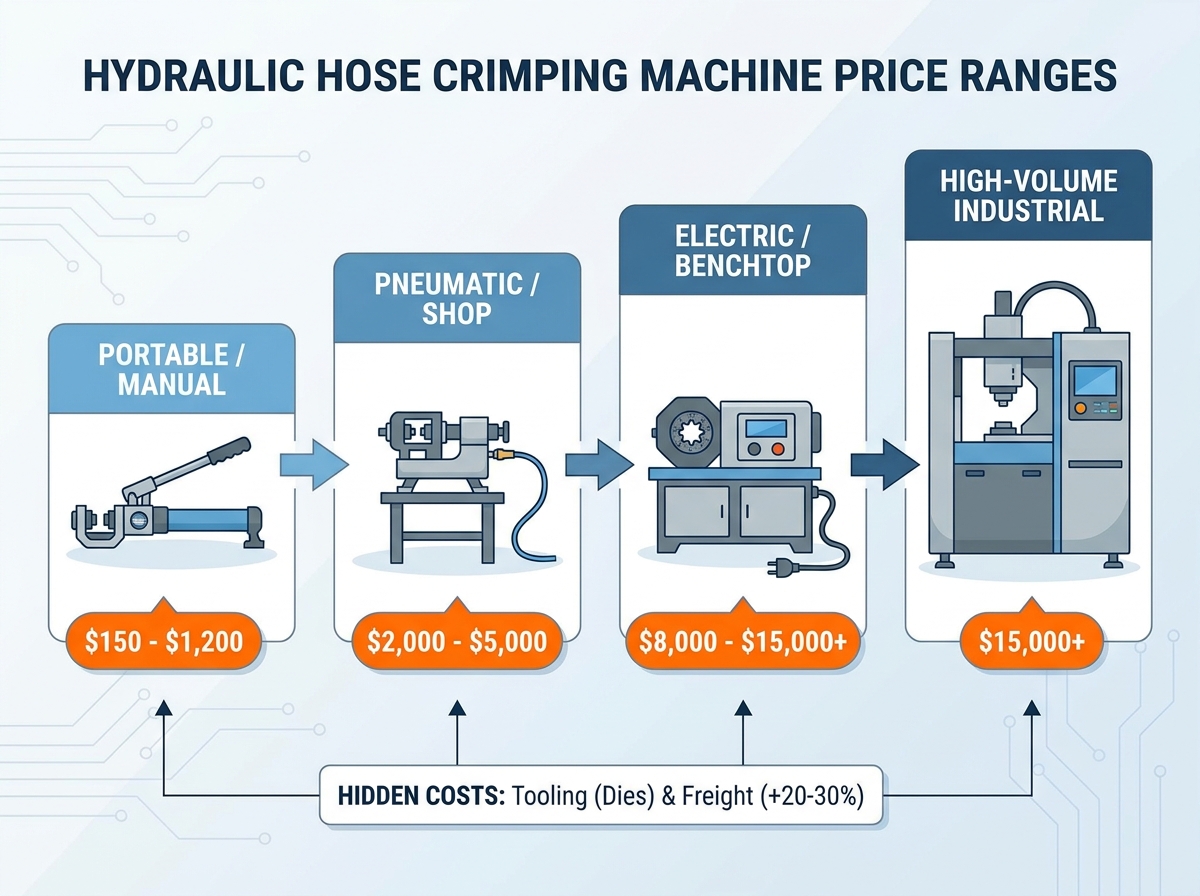
Finding accurate cost data matters deeply for your business operations. Prices range drastically across the market. You can pay $150 for basic manual tools. Conversely, you might spend over $15,000 for high-volume industrial units. Buying blindly means you risk overspending or acquiring a unit unable to handle your daily workload.
This guide breaks down exact price brackets for various models available today. We also reveal hidden ownership expenses you must budget for before buying. Finally, you will learn how to evaluate the exact return on investment for bringing your hose assembly in-house.
Key Takeaways
Entry-Level/Portable: Manual and pneumatic field crimpers typically cost between $150 and $1,200.
Standard Shop/Benchtop: Electric hydraulic hose crimping machines range from $2,000 to $5,000.
Industrial/Production: High-volume, programmable machines cost $8,000 to $15,000+.
Hidden Costs: Tooling (die sets) and freight shipping are the two largest unbudgeted expenses, often adding 20-30% to the initial sticker price.
ROI Trigger: Purchasing a machine generally pays for itself if your operation replaces more than 5-10 hydraulic hoses per month or suffers high downtime costs.
Price Ranges by Machine Category
Manual & Portable Crimpers ($150 – $800)
Manual units provide a highly economical entry point for basic hose repairs. They operate via a hand pump mechanism. You do not need external power sources. This independence makes them best for occasional mobile field repairs. They excel in low-pressure applications and strict budgets. Forestry crews and remote agricultural workers often rely on these lightweight tools.
Their capabilities fit smaller assembly needs. Typically, they handle 1/4" to 1" diameter hoses. They comfortably crimp 1-wire and 2-wire braided lines. However, they carry distinct limitations. Operation remains quite slow. The process depends heavily on operator physical strength. Consequently, you get lower crimping precision compared to automated units. Fatigue can lead to inconsistent assemblies during long repair days.
Air/Pneumatic Crimping Machines ($800 – $2,500)
Pneumatic crimpers step up the efficiency scale significantly. They utilize an air-over-hydraulic pump system. This design makes them best for mobile service trucks. Small repair shops already equipped with heavy-duty air compressors also benefit greatly. They remove the physical labor required by manual hand pumps.
These units deliver much faster cycle times. The capabilities rely entirely on the connected pneumatic pump. Limitations naturally follow the air supply system. You require a highly reliable air compressor. Without consistent pressure, the dies will not fully close. Maximum tonnage usually caps out around 1" to 1-1/4" 4-wire hoses. They struggle to compress thicker multi-spiral industrial lines.
Electric Benchtop Crimpers ($2,000 – $6,000)
Electric benchtop models form the backbone of modern repair facilities. They are best for agricultural operations and standard maintenance shops. Heavy equipment fleets also use them daily. A quality hydraulic hose crimping machine in this category offers immense versatility. They provide the perfect balance between speed, power, and footprint.
Capabilities include push-button or foot-pedal operation. This hands-free control increases operator safety. They easily handle up to 2" lines. They power through heavy 4-wire or 6-wire spiral hoses. However, limitations center on infrastructure. You require dedicated 110V or 220V shop power. You also sacrifice portability. Once bolted to a workbench, these heavy units stay put.
High-Volume Production Crimpers ($8,000 – $15,000+)
Industrial units serve a completely different market segment. They are best for OEM manufacturing facilities. Dedicated hose assembly businesses also require this tier of equipment. These facilities produce hundreds of identical assemblies daily. They demand absolute precision and repeatable accuracy.
Capabilities feature advanced digital controllers and auto-stop features. Tonnage ratings easily exceed 250 tons. They offer incredibly fast cycle times. They effortlessly handle massive multi-spiral industrial hoses. The limitations heavily involve high capital expenditure. Furthermore, they require extensive floor space. You will also need dedicated 3-phase power installed by a commercial electrician.
Machine Category
Average Price Range
Power Source
Max Hose Capability
Manual / Portable
$150 - $800
Hand Pump
1" (2-wire)
Air / Pneumatic
$800 - $2,500
Air Compressor
1-1/4" (4-wire)
Electric Benchtop
$2,000 - $6,000
110V / 220V AC
2" (4-wire / 6-wire)
Industrial Production
$8,000 - $15,000+
3-Phase Power
Massive Multi-Spiral
Key Factors That Determine a Hydraulic Hose Crimping Machine’s Price
Crimping Force (Tonnage)
Prices scale directly alongside hydraulic cylinder power. Tonnage dictates how much compressive force the machine applies to the metal fitting. A standard 60-ton machine costs vastly less than a massive 280-ton machine. You need higher tonnage to crush the thick steel collars found on high-pressure lines. Entry-level units simply lack the physical strength required for severe industrial applications. Buyers must match tonnage ratings to their most extreme daily requirements.
Hose Capacity (Diameter & Rating)
Capacity limits significantly impact manufacturing costs. Machines rated only for 1" 2-wire hose remain relatively affordable. They utilize smaller pumps and lighter steel frames. Conversely, machines capable of crimping 2" 6-wire spiral hoses require premium structural steel. The internal framework must withstand immense internal stress during the compression cycle. Upgrading to larger pumps and thicker steel plates drives the retail price upward substantially.
Included Die Sets
Tooling packages drastically alter the final invoice. Manufacturers sell some machines completely "bare" to advertise a lower base price. Other vendors include a comprehensive bundle of 5 to 10 standard die sets. A seemingly cheaper machine quickly becomes expensive if you must purchase dies separately. Always verify exactly which sizes come inside the shipping crate. You should calculate the total package value rather than just the base unit price.
Brand Reputation & Component Quality
Established B2B brands predictably charge a premium. Companies like Parker, Gates, and Weatherhead maintain strict manufacturing tolerances. They invest heavily in international safety certifications. More importantly, they guarantee long-term replacement parts availability. Premium brands use high-grade seals, reliable motors, and hardened steel components. You pay extra upfront to avoid catastrophic mechanical failures during critical production runs. Peace of mind carries a definitive price tag.
The "Affordable" vs. Premium Debate: Assessing the Risks
The Appeal of Economy Brands
Online marketplaces currently flood buyers with low-cost imported crimpers. You frequently see them heavily discounted on Amazon or eBay. Their price tags appear incredibly appealing. These budget units definitely serve a specific purpose. They work well for weekend hobbyists building custom tractor implements. They also provide a decent backup solution for extreme field emergencies. However, professional mechanics should approach them cautiously.
Tolerance Drift & Safety
Economy machines often utilize cheaper, softer metals inside generic dies. Under repeated heavy pressure, these cheap metals warp slightly. This warping leads to tolerance drift. An improper crimp causes catastrophic hose blowouts under pressure. Blowouts lead to massive hydraulic fluid loss and steep environmental fines. Worse yet, fluid injection injuries cause severe operator trauma. Safety standards dictate you must secure fittings precisely.
After-Sales Support
Premium machines arrive backed by comprehensive technical support. Manufacturers provide detailed calibration instructions and nationwide warranty networks. If a component fails, you receive immediate assistance. Economy machines routinely lack replacement parts entirely. If a cheap cylinder seal blows, you cannot simply order a replacement. The entire unit often becomes useless scrap metal. If you need reliable guidance on tooling compatibility, you can always contact us for professional advice.
Verdict
You must tie your purchasing decision directly to application risk. Consider the worst-case scenario of a sudden line failure. If your newly assembled hose runs a 4,000 PSI excavator boom, do not cut corners. Invest in a premium, verifiable machine capable of hitting exact tolerances. Alternatively, if you only build low-pressure return lines for light agricultural tools, an economy brand might suffice. Weigh your safety liabilities carefully.
Hidden Costs: What to Budget Beyond the Sticker Price
Extra Die Sets
Standard tooling kits rarely cover every single fitting profile. You will eventually encounter odd metric sizes or specialized heavy-duty fittings. When this happens, you must purchase individual supplemental dies. You should comfortably budget $150 to $350 per additional die set. Specialized profiles often cost even more. Map out your most frequent repairs beforehand to ensure you own the right steel blocks.
Freight Shipping
Logistics add a surprising penalty to your final bill. Standard benchtop machines easily weigh between 200 and 500+ lbs. They cannot travel through conventional parcel networks. Suppliers must ship them via LTL (Less-Than-Truckload) freight. If your facility lacks a loading dock or forklift, you need a liftgate service. Liftgate requirements and residential delivery fees quickly add $200 to $500 directly onto the invoice.
Hydraulic Fluid & Setup
Freight regulations strictly prohibit shipping equipment full of combustible fluids. Consequently, many machines ship completely dry. The buyer holds responsibility for supplying the necessary operational fluids. You must factor in the cost of premium AW32 or AW46 hydraulic oil. A large reservoir might require several gallons of fluid before you can perform a single test cycle. Keep these supplies stocked locally.
Calibration Tools
You cannot assemble safe lines without verifying your final dimensions. Every fitting manufacturer publishes specific crimp diameter charts. You must measure your finished assemblies against these exact specifications. Doing so requires high-quality digital calipers and precise micrometers. Do not rely on cheap plastic measuring tools. Budget for professional-grade measurement instruments to guarantee structural integrity and workplace safety.
ROI Framework: Does It Make Sense to Buy Your Own?
The Cost of Outsourcing
Start by calculating the average financial penalty of driving to a local hydraulic shop. Shops typically charge between $50 and $150 per custom hose assembly. This price includes their labor and retail markup. However, you must also add your travel expenses. Fuel costs and the hourly wage of the employee driving to the store add up quickly. Outsourcing drains cash flow slowly but steadily over a busy operating year.
The Cost of Downtime (The Real Metric)
Downtime represents the most devastating hidden metric in heavy industry. You must calculate the hourly revenue lost while heavy machinery sits idle. Imagine an excavator generates $150 per hour in revenue. A line blows, and it waits 3 hours for a replacement part. The true downtime cost equals $450 in lost productivity. This number dwarfs the actual retail price of the rubber hose itself. Speed of replacement matters intensely.
The Break-Even Point
We can easily map out a practical break-even scenario. Consider a standard $3,000 electric shop crimper. Now, factor in the severe machine downtime costs mentioned above. If one blown hose costs you $450 in lost time, the math becomes clear. The equipment literally pays for itself in less than 7 blown hoses. For a moderately busy construction fleet, you reach this threshold within a few months.
Shortlisting Logic
Buyers often make critical mistakes during the sizing phase. They look at their fleet and buy equipment based on their average hose size. This approach guarantees future frustration. Instead, choose your machine based on the largest, thickest hose currently active in your fleet. You need the capacity to fix your worst-case breakdown. Follow this straightforward decision process:
Audit every piece of heavy machinery in your yard.
Identify the single largest diameter high-pressure line.
Count the internal wire braids on that specific line.
Purchase equipment rated slightly above that maximum threshold.
Conclusion
The true cost of bringing assembly capabilities in-house extends far beyond the base unit. You must properly budget for the initial unit, freight shipping, hydraulic fluids, and necessary dies. Transparency prevents painful financial surprises during the setup phase.
Always remember that buying cheap creates massive liabilities for high-pressure industrial applications. Faulty assemblies risk human safety and environmental compliance. Conversely, over-buying a massive 300-ton machine hurts cash flow for small repair shops. You must find the precise balance between safety and financial efficiency.
Your next step requires immediate action. Encourage your maintenance team to audit your current fluid conveyance sizes. Document the diameter and wire count of your most critical lines. Use this data to narrow down your required tonnage strictly before requesting quotes or browsing inventory.
FAQ
Q: Can I buy a used hydraulic hose crimper?
A: Yes, the secondary market offers substantial savings. However, you must inspect used equipment thoroughly. Always check the main cylinder for slow fluid leaks. Examine the included dies closely for internal wear, rust, or warping. A machine with worn dies cannot hit required safety tolerances and poses a significant blowout risk.
Q: Are crimper dies interchangeable between brands?
A: Generally, no. Most premium manufacturers utilize proprietary die setups engineered specifically for their own cylinders. A few generic import brands share universal designs, but you should never assume compatibility. Always confirm tooling compatibility with the manufacturer before attempting to swap components.
Q: Do I need a special electrical outlet for a benchtop crimper?
A: It depends heavily on the model you select. Smaller benchtop units run perfectly fine on standard 110V household outlets. Mid-range models often require a dedicated 220V single-phase circuit. High-volume industrial machines strictly require commercial 3-phase power setups. Always verify electrical requirements before finalizing your purchase.
Q: Can a hydraulic hose crimping machine do AC hoses or battery cables?
A: Yes, many machines offer excellent cross-functionality. You can successfully assemble automotive AC lines, battery cables, and wire ropes. However, you must purchase the specific die sets designed for those softer materials. Attempting to crush battery cables using standard high-pressure hydraulic dies will destroy the terminals instantly.
Handanshi Kangmai Hydraulic Equipment Co., Ltd. is located in the east of Wangzhuang,on the Hanlin expressway. Our main products have 9 series and 50 types which contains hose crimping machine, hose cutting machine,hose skiving machine...