In hydraulic systems operating at 3,000 to 6,000+ PSI, a hose assembly is only as reliable as its crimp. Using the wrong crimping die size doesn't just cause leaks; it creates catastrophic blowout risks and expensive unplanned downtime. High-pressure fluid injection injuries pose severe threats to operators. A single failed connection can halt an entire production line.
Many technicians historically rely on "tribal knowledge" or trial-and-error methods. Modern high-pressure hoses absolutely require strict adherence to manufacturer specifications and official crimp charts. Tolerances are tighter today. The materials are much stronger. Guesswork simply does not belong in modern hydraulic maintenance routines.
This guide provides a definitive, engineering-backed framework for evaluating, selecting, and verifying the exact die for your hydraulic hose assemblies. We will explore safety standards, core selection parameters, and the specific procurement criteria needed to upgrade your operation.
Key Takeaways
Never guess: Crimping die size is dictated by the precise combination of hose type, hose Outer Diameter (OD), and the specific fitting being used.
Manufacturer data is law: Always consult the official crimp data manual (e.g., Gates, Kuriyama) for the target crimp diameter before selecting a die.
Die range matters: Select a die where your target crimp diameter falls close to the middle of the die’s operating range to prevent metal fatigue and uneven crimping.
Verification is non-negotiable: The selection process isn't complete until the finished crimp is measured with calibrated digital calipers to ensure it matches the spec chart.
The Business & Safety Case for Exact Die Selection
Safety & Compliance
Safety remains the absolute primary concern in hydraulic maintenance. Incorrect crimps present immediate physical dangers to everyone nearby. Under-crimping a hose leads to sudden blowouts under pressure. The fitting simply shoots off the hose end. Over-crimping causes equally severe issues. It crushes the inner tube and restricts vital fluid flow. Restricted flow generates excess heat and destroys system pumps.
We must adhere strictly to established safety protocols. Organizations like SAE (Society of Automotive Engineers) and ISO (International Organization for Standardization) publish clear guidelines. SAE J517 and ISO 1436 dictate specific performance requirements. Following these standards ensures operator safety and environmental protection.
Financial Impact
Incorrect selection heavily impacts your bottom line. Wasted fittings and scrapped hoses add up quickly. Voided OEM warranties present an even larger financial threat. Manufacturers will not honor claims on improperly assembled hoses. The hidden costs of equipment downtime far outweigh any time saved by skipping the spec sheet.
Imagine a large excavator stopping mid-project. The physical hose replacement costs only a few dollars. However, the operational delay costs thousands of dollars per hour. Proper die selection prevents these disastrous financial scenarios.
The "Good Enough" Fallacy
We often encounter a dangerous DIY mentality online. Forums like Pirate4x4 sometimes suggest modifying dies to fit mismatched hoses. Users occasionally advise eyeballing the pressure gauge until the fitting looks tight. You must avoid this mindset completely.
These amateur shortcuts fail spectacularly in commercial or heavy-duty applications. A farm tractor or an industrial press demands absolute precision. Industrial hydraulic systems do not tolerate "good enough." You must trust engineering data over forum opinions.
Core Parameters: What Dictates Your Crimping Die Size?
Hose Specifications (ID vs. OD)
You cannot select a die based purely on the hose size you bought. Manufacturers sell hoses by Inner Diameter (ID) or "Dash Size." The ID determines the fluid flow rate. However, the outer parameters dictate the necessary tooling.
The Outer Diameter (OD) directly dictates your die selection. The internal construction also plays a massive role. You must count the wire braids inside the rubber. Common configurations include:
1-wire braided construction (low to medium pressure)
2-wire braided construction (standard high pressure)
4-spiral or 6-spiral wire construction (extreme high pressure)
A 4-spiral hose requires far more compression force than a 1-wire hose. It also has a thicker outer diameter. These physical differences demand specific die sets.
Skive vs. Non-Skive Hoses
Skiving drastically alters your assembly approach. Some hoses require you to remove the outer rubber cover before crimping. We call this process skiving. Skiving exposes the steel wire reinforcement beneath the surface. The fitting ferrule then bites directly into the steel.
Skiving changes the final OD of the hose end completely. A skived hose end is noticeably thinner than a non-skive hose end. Because the diameter shrinks, you must use a completely different die. Attempting to crimp a skived hose using a non-skive die will fail. The fitting will barely compress, leading to a guaranteed blowout.
Fitting Compatibility
Fitting styles vary wildly between manufacturers. Ferrule thickness must precisely match the hose type. The fitting series determines the required compression force and the overall die footprint. A two-piece fitting operates differently than a one-piece fitting.
You must ensure the fitting length fits entirely inside the die segments. If the fitting exceeds the die length, you will create an uneven crimp. We call this bell-mouthing. It ruins the holding power of the assembly. Always verify compatibility between the hose, the fitting, and the die length.
The Step-by-Step Framework for Determining Crimping Die Size
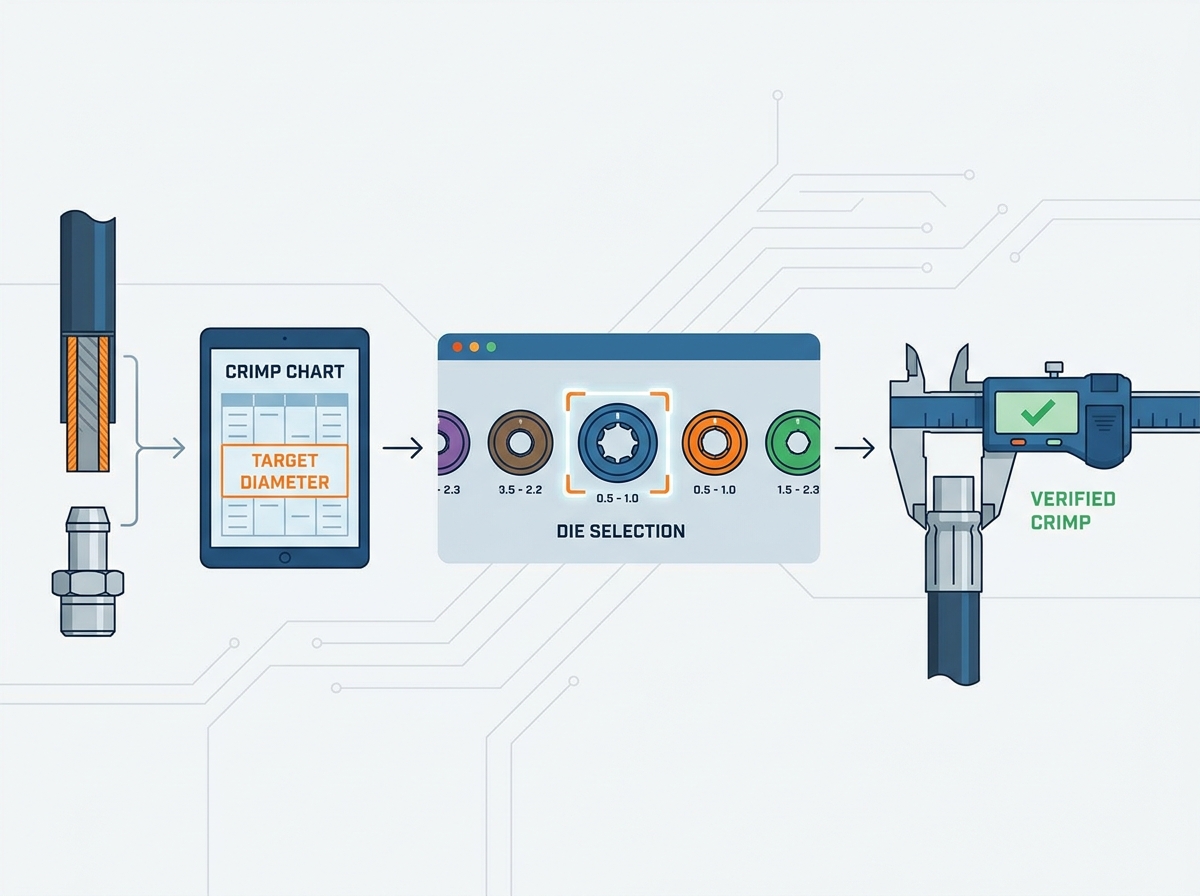
Step 1: Consult the Manufacturer’s Crimp Data Chart
You must locate the specific chart for your exact brand of hose and fitting. Never use a Gates chart for a Parker hose. Cross-reference the hose dash size and the fitting series on the document. Read across the columns to find the required Target Crimp Diameter.
This target diameter serves as your ultimate goal. Everything you do moving forward aims to achieve this exact measurement. It represents the perfect compression level for the ferrule teeth to grip the wire braid.
Step 2: Match Target Diameter to the Die’s Range
Next, look at your crimping machine’s die set specifications. Dies cover specific physical ranges. One set might cover 16mm to 19mm. Another might cover 19mm to 22mm. Choose the die where your Target Crimp Diameter falls comfortably within the stated range.
Ideally, your target should sit near the middle of the operating range. Avoid selecting a die where the target sits at the extreme minimum or maximum. Working at the extremes causes metal fatigue in the die segments. It also promotes uneven crimping profiles across the ferrule.
Step 3: Factor in Micrometer Settings
Your crimping machine relies on precise mathematical adjustments. You must understand the mathematical relationship between the base die size and the micrometer dial. Setting the dial correctly tells the machine exactly when to stop compressing.
Use a standardized formula approach to find your setting. Subtract the base die size from your target crimp diameter. The resulting number dictates your micrometer setting.
Standard Machine Calibration Variables
Variable Name
Definition & Purpose
Common Source
Target Crimp Diameter
The exact final outside measurement of the compressed ferrule.
Manufacturer Data Chart
Base Die Size
The lowest possible diameter the specific die segment can achieve safely.
Stamped on the die face
Micrometer Setting
The dialed offset instructing the machine to halt hydraulic pressure.
Calculated via formula
Implementation Risks: Why Correct Die Sizes Still Fail
"Mix and Match" Brand Mismatches
A theoretically perfect size calculation means nothing if you mix brands improperly. We strongly warn against using Brand A's hose alongside Brand B's fitting. You absolutely cannot use Brand C's crimp chart to assemble them. Thread geometries and ferrule tapers differ widely across manufacturers.
The industry demands a validated system approach. Manufacturers test their hoses exclusively alongside their own proprietary fittings. Mixing components voids all safety guarantees. It introduces unpredictable stress points inside the assembly.
Equipment Wear and Tear
Tooling degrades over time. Unmaintained dies flare or warp after thousands of cycles. Heavy usage rounds off the sharp gripping edges. A theoretically correct calculation produces a faulty assembly if the die is heavily worn.
You must establish a regular inspection schedule. Look for galling on the sliding surfaces. Check for uneven gaps between the segments. Worn tooling causes oval-shaped crimps instead of perfectly round ones. Oval crimps leak fluid under high pressure.
Measurement Errors (The Vernier Caliper Rule)
Mistakes frequently happen on the shop floor during the verification phase. Technicians must measure the finished crimp accurately using digital calipers. You must measure the flat surfaces of the ferrule. You must avoid the raised ridges completely.
We call these ridges "witness marks." The small gaps between the die segments create these marks during compression. Measuring across the witness marks inflates your reading. It tricks you into thinking the crimp is too large. Always place your caliper jaws on the smooth, flat compressions.
Procurement Criteria: Upgrading Your Hydraulic Hose Crimper Dies
Material and Hardening
Buyers must evaluate dies based on alloy strength. High-volume commercial environments require hardened tool steel. D2 tool steel offers exceptional wear resistance for continuous industrial use. These dies withstand thousands of repetitive high-pressure cycles daily.
Standard sets might suffice for low-volume mobile repair trucks. Mobile technicians assemble fewer hoses per week. They can safely prioritize lower costs over maximum hardness. However, industrial shops must invest in premium, hardened materials to ensure longevity.
Color-Coding and UX
User experience matters in a busy shop environment. We highly recommend visually coded die sets. Premium brands often anodize or paint their dies in specific colors based on size ranges. This simple feature reduces human error during rapid changeovers.
A technician can instantly identify the red set for 1/4-inch hoses. Color-coding eliminates the need to squint at tiny stamped numbers. It speeds up production and prevents accidental size mismatches.
OEM vs. Aftermarket Dies
Procurement teams constantly debate OEM versus aftermarket options. We provide a balanced view. OEM dies guarantee full warranty compliance. They match the manufacturer's exact specifications. You never worry about compatibility issues.
Aftermarket dies often provide significant upfront cost savings. Many perform adequately in standard applications. However, they carry strict liability risks. Aftermarket dies sometimes fail to match the machine’s internal taper angle perfectly. A mismatched angle causes the die to bind inside the crimper bowl.
Next Steps
We advise buyers to conduct an immediate audit of their facilities. Identify your most frequently assembled hoses. Document the dash sizes and pressure ratings you handle daily. Determine which baseline kits you must invest in immediately.
Replace any worn or warped segments you discover. Prioritize replacing your core sizes first. A small investment in fresh tooling prevents massive liability claims down the road.
Conclusion
Choosing the correct specification is a rigid, data-driven process. It requires diligence and attention to detail. It is never an estimation or a guessing game. Every parameter matters, from the outer diameter to the internal wire braids.
The best hydraulic assembly requires synergy. The hose, fitting, die, and spec chart must all share a validated, manufacturer-approved relationship. Shortcuts in this industry inevitably lead to catastrophic mechanical failures and severe safety hazards.
We encourage you to download an official crimp spec sheet today. To explore compatibility options or verify your crimping die size requirements for upcoming projects, contact a technical sales representative or browse our complete catalog of precision-machined tooling.
FAQ
Q: Can I use a larger die and just adjust the micrometer setting further down?
A: No. Adjusting the micrometer too far down causes the die segments to bottom out against each other. They will pinch the ferrule incorrectly instead of providing even radial compression. This damages your machine and creates unsafe, leaking assemblies. Always select a die range that naturally fits your target.
Q: How often should I measure my finished crimps to verify die accuracy?
A: We highly recommend measuring the first assembly of every new batch. For high-production manufacturing runs, technicians must verify the diameter daily. Regular measurement catches early signs of die wear, machine calibration drift, or accidental micrometer adjustments. It prevents scrapping entire batches of expensive hoses.
Q: Does the crimping die size change if I use a stainless steel fitting instead of carbon steel?
A: Generally, the target diameter remains dictated by the manufacturer's specification chart regardless of material. However, stainless steel is significantly harder than carbon steel. The machine may require higher hydraulic pressure to reach that target diameter. Always consult the specific material's chart to confirm exact variables.
Handanshi Kangmai Hydraulic Equipment Co., Ltd. is located in the east of Wangzhuang,on the Hanlin expressway. Our main products have 9 series and 50 types which contains hose crimping machine, hose cutting machine,hose skiving machine...