Purchasing the wrong equipment raises your operational stakes significantly. A mismatched hose crimping machine easily leads to inconsistent crimps, costly hydraulic failures, and unplanned downtime. You simply cannot afford unexpected equipment failures when project deadlines loom. Perhaps you are currently scaling your production capacity to meet new demand. You might be bringing repairs in-house to cut external supplier dependencies. Alternatively, you may need to upgrade legacy equipment failing to meet modern safety tolerances.
This guide serves as an objective, spec-by-spec evaluation framework. We will help you eliminate unsuitable models systematically from your purchasing list. You will learn how to shortlist machines based on verifiable return on investment and practical operational realities. By evaluating key criteria upfront, you ensure your shop stays productive, safe, and highly profitable.
Key Takeaways
Match machine capacity not just to your current hose diameters, but to your thickest multi-wire spiral hoses (e.g., 4SP, 6SP) and complex fittings (e.g., 90-degree elbows).
Control system choice (Micrometer vs. Digital/PLC) should be dictated by your production volume and operator turnover rate.
Prioritize suppliers that provide transparent warranty terms, verifiable compliance (CE/ISO), and localized replacement parts.
1. Frame Your Production Needs and Success Criteria
Assess Volume and Environment
You must distinguish your shop's specific environment before reviewing any machine specifications. High-mix, low-volume setups usually describe local hydraulic repair shops. They face unpredictable daily requirements, building different assemblies every hour. Low-mix, high-volume environments represent OEM production lines doing highly repetitive batches. Field service setups handle mobile repairs directly on remote job sites. Each environment demands entirely different machine architectures. A heavy production plant requires stationary stability. A mobile repair truck needs lightweight agility. You should align your equipment search strictly with your physical working environment.
Identify Bottlenecks
Why are you buying new equipment right now? You should clearly define what a successful purchase looks like for your team. Is your primary goal to speed up cycle times during large batch runs? Maybe you need to reduce operator error during complex, high-pressure assemblies. Sometimes, shops just need the raw ability to handle larger bore hoses. Identify your specific bottleneck immediately. This prevents you from paying for flashy features you will never actually use on the shop floor.
Future-Proofing
Evaluate your facility's long-term business plans carefully. Will you take on heavier industrial contracts in the next three to five years? If you plan to expand into heavy agriculture or mining support, do not under-size your machine today. Buying a larger capacity unit now prevents forced upgrades later. Contract requirements often change suddenly. You want a machine capable of growing alongside your business volume. An undersized unit limits your ability to bid on lucrative heavy-duty projects.
2. Categorize Hose Crimping Machine Types by Application
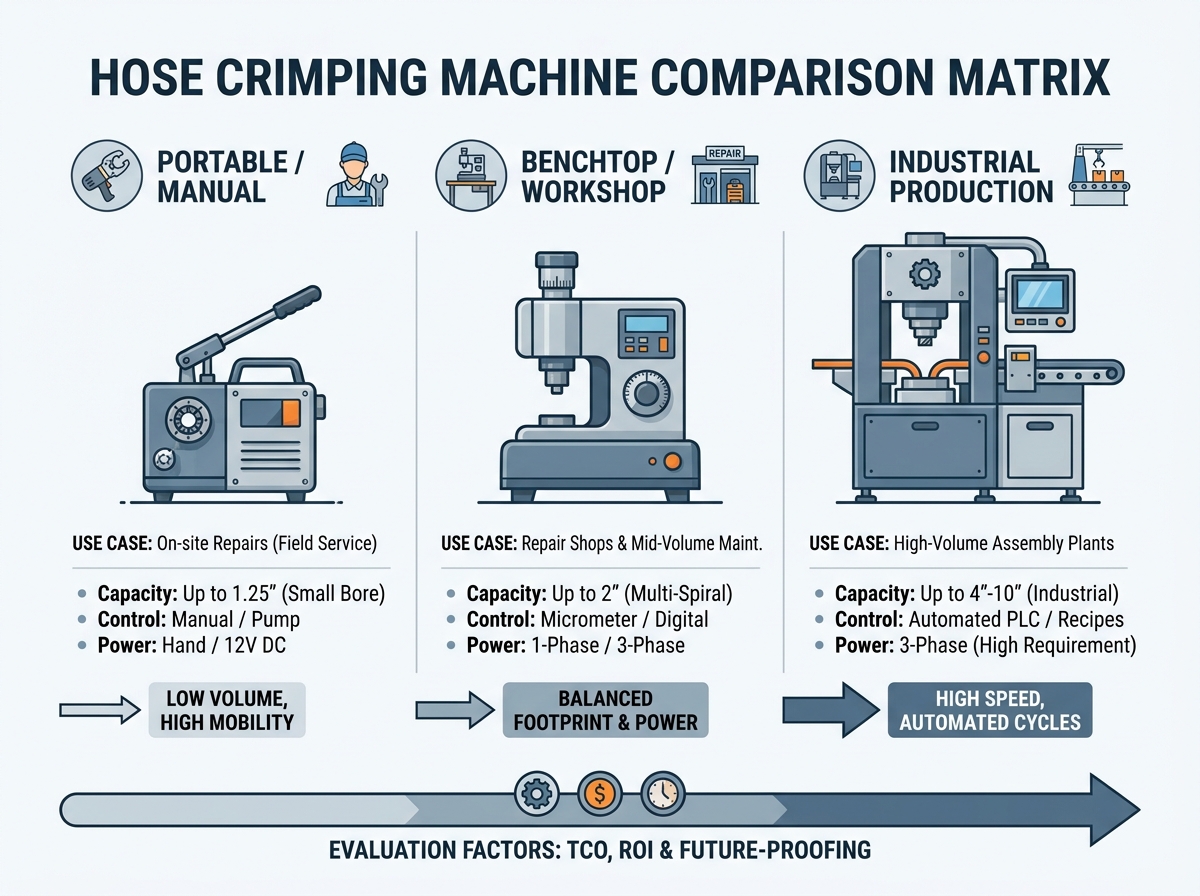
Portable and Manual Crimpers (Field Service)
These compact units excel in on-site emergency repairs. Agriculture and construction sectors rely on them heavily to minimize equipment downtime. They save you from hauling broken tractors or excavators back to a central repair shop. However, they carry distinct mechanical limitations. They typically operate via manual hand-pumps or 12V/24V truck power supplies. You will find their maximum capacity strictly capped at smaller diameters. They generally handle 1-inch to 1.25-inch hoses safely. Pushing them beyond this limit risks poor crimp integrity.
Benchtop and Workshop Crimpers (Standard Retail/Repair)
Hydraulic repair shops and mid-sized maintenance bays heavily utilize benchtop units. They perfectly balance a manageable physical footprint with highly reliable power. A standard benchtop model comfortably handles up to 2-inch multi-spiral hoses. They sit easily on a sturdy workbench without requiring massive floor space. Their versatility makes them the backbone of general hydraulic maintenance. Most retail shops consider them the standard entry point for professional-grade assemblies.
Industrial Production Crimpers (High-Volume)
Dedicated hose assembly plants need these stationary production giants. They offer incredibly high-speed cycle times for maximum output. They often feature automated PLC controls designed for massive batch runs. They easily crimp massive 4-inch to 10-inch industrial hoses without hesitation. You must deliberately accommodate their heavy, stationary footprint on your factory floor. They represent a significant capital investment geared purely toward volume manufacturing.
Equipment Category
Primary Use Case
Key Strengths
Notable Limitations
Portable / Manual
Field service, remote job sites
Highly mobile, battery/hand operated
Low capacity, slower cycle times
Benchtop / Workshop
Retail shops, maintenance bays
Great versatility, moderate footprint
Not suited for massive industrial bore sizes
Industrial Production
OEM manufacturing, high-volume plants
Extreme speed, heavy tonnage capacity
Large footprint, requires complex logistics
3. Core Evaluation Dimensions: Specs vs. Real-World Outcomes
Crimping Force (Tonnage) vs. Hose Type
Machine tonnage often acts as a deceptive vanity metric in sales brochures. You should never evaluate a machine solely by its maximum advertised force. A 200-ton machine easily crimps a standard 2-inch 2-wire hose. However, it will likely struggle to properly compress a rigid 2-inch 6-wire spiral hose. The density of the steel braiding dictates the actual force required. You must assess the crimping force relative to your toughest, thickest assemblies. Always prioritize the hose wire count over the generic tonnage number.
Opening/Max Capacity & Die Ranges
Always examine the head opening size without the dies installed. This raw opening metric determines if the machine clears complex configurations. You must ensure the head easily clears 90-degree swept fittings or large custom flanges after the crimp completes. A machine with a small opening traps angled fittings inside the head. Additionally, check the die sets closely. Verify exactly what standard die sets come included in the crate. Determine early what sizes must be purchased as expensive custom add-ons.
Control Systems & Repeatability
Your control system dictates operational consistency across different shifts. A micrometer dial system remains durable, simple, and very cost-effective. However, it requires highly skilled operators to avoid gradual calibration drift over time. Conversely, Digital or PLC controls require a higher upfront investment. They enable operators to save specific crimp recipes directly into the computer. This digital consistency proves crucial for environments facing high employee turnover. It ensures standardized repeatability regardless of who currently operates the machine.
Power Requirements
Buyers frequently overlook their own building's electrical constraints. You must carefully verify if your facility supports single-phase or 3-phase power. Check your main electrical panel before finalizing any equipment purchase. Heavy industrial models draw massive amperage during the compression cycle. Match the machine's specific motor requirements to your building's current electrical capacity. Ignoring this step leads to expensive electrician bills. Sometimes it results in entirely unusable equipment sitting idle on your floor.
4. Implementation Realities, Hidden Costs, and Risks
Tooling and Quick-Change Systems
You must assess the physical ease of swapping dies between jobs. In a high-mix repair shop, operators change dies constantly throughout the day. A machine lacking a rapid quick-change tool will aggressively bleed your labor hours. Manual die insertion takes frustratingly long and fatigues the operator's hands. Quick-change systems let your team swap an entire die set in seconds. This small mechanical feature drastically improves daily throughput.
Freight and Commissioning
Industrial machines are exceptionally heavy pieces of factory equipment. They require careful, proactive logistical planning before they ship. You must factor in specialized heavy freight handling. Ensure your facility has the proper forklift requirements for safe, level unloading. Do not forget to account for professional installation costs. Some units require hardwiring directly to your electrical grid by a licensed contractor. Plan these logistics weeks before the delivery truck arrives.
Maintenance & Wear
Focus closely on the crimper head design and lubrication needs. You will choose between grease-free and traditionally greased head designs. Grease-free models run cleaner but may exhibit different friction characteristics under heavy load. Greased heads require strict adherence to a messy daily lubrication schedule. You must also account for the physical reality of replacing internal wear pads over time. Annual calibration routines also demand planned maintenance downtime to keep tolerances exact.
5. The Shortlisting Framework: How to Make the Final Decision
Requesting Proof of Capability
Never trust a generic specification sheet alone when spending capital. We strongly advise buyers to demand physical proof before cutting a check. Follow these specific steps to verify machine capability:
Send actual sample hoses to the manufacturer's testing facility.
Provide your most challenging, oddly shaped fittings for the test run.
Request an uncut, unedited video showing the full cycle time.
Examine the returned sample for perfect circularity and proper compression.
This visual proof guarantees the machine handles your specific components without binding or struggling.
Vendor Due Diligence
Your equipment supplier matters just as much as the physical hardware. You must verify their post-sale support infrastructure. Pay close attention to these critical vendor factors:
Verify local replacement parts availability to prevent long shipping delays.
Check if the hydraulic valves and internal motors are standard off-the-shelf components.
Look for official CE or ISO compliance markings stamped securely on the chassis.
Read the warranty fine print carefully to spot hidden exclusions.
You must differentiate between coverage for structural steel, hydraulic labor, and consumable wear-and-tear items like dies.
ROI Calculation
Balance your upfront capital expenditure against tangible operational improvements. A premium machine requires more initial budget but delivers major projected time savings. It drastically reduces expensive scrap rates caused by asymmetrical, leaking crimps. Quality machines run faster, allowing you to process more assemblies per shift. Finally, a highly capable machine expands your overall service offerings. It allows you to bid on lucrative high-pressure industrial contracts. If you need expert guidance navigating these specifications, do not hesitate to contact us for a customized evaluation.
Conclusion
The best equipment is never simply the model boasting the highest maximum tonnage. It is the specific machine aligning perfectly with your actual production volume, power availability, and safety requirements. Rushing a capital purchase often leads to frustrating bottlenecks you were originally trying to eliminate. Take the time to audit your current hose failure rates. Document your most frequent assembly sizes and fitting styles. Review your facility's electrical panels thoroughly. We encourage you to reach out to a technical sales engineer to discuss a custom capacity assessment tailored strictly to your shop's daily reality.
FAQ
Q: Can I use a benchtop hose crimping machine for heavy equipment repairs?
A: Yes, but only within strict structural limits. A quality benchtop crimper easily handles standard 2-wire and 4-wire hydraulic hoses up to 1.5 inches. However, heavy earthmoving equipment often utilizes extremely rigid 6-wire spiral hoses. Many standard benchtop models lack the necessary crimping force and die clearance for these 6-wire assemblies. Always verify the machine's maximum spiral hose rating before attempting heavy-duty repairs.
Q: Do I need to buy extra die sets immediately?
A: Most manufacturers include a standard die package covering common hydraulic hose sizes ranging from 1/4-inch to 2-inch. You only need extra sets immediately if you assemble highly specialized configurations. Automotive air conditioning hoses, industrial Teflon tubing, or extreme metric sizes typically require custom die sets. These niche sizes are rarely included in standard retail packages.
Q: How often does a hose crimper need to be calibrated?
A: You should perform a brief visual check and test crimp daily. For official calibration, industry safety standards recommend checking the micrometer or digital readout annually. High-volume production environments may require bi-annual calibration to ensure exact tolerances hold steady. Regular calibration strictly prevents costly fluid leaks and maintains the structural integrity of your hose assemblies.
Q: Is a used or refurbished crimping machine worth the risk?
A: Used machines offer tempting cost savings for first-time buyers. However, they carry significant operational risks. Worn master dies create oval, leaking crimps. Outdated hydraulic cylinders frequently suffer from failing internal seals. If you must choose a refurbished model, only buy from certified dealers. Demand a documented pressure test and a clear warranty covering the major hydraulic components.
Handanshi Kangmai Hydraulic Equipment Co., Ltd. is located in the east of Wangzhuang,on the Hanlin expressway. Our main products have 9 series and 50 types which contains hose crimping machine, hose cutting machine,hose skiving machine...