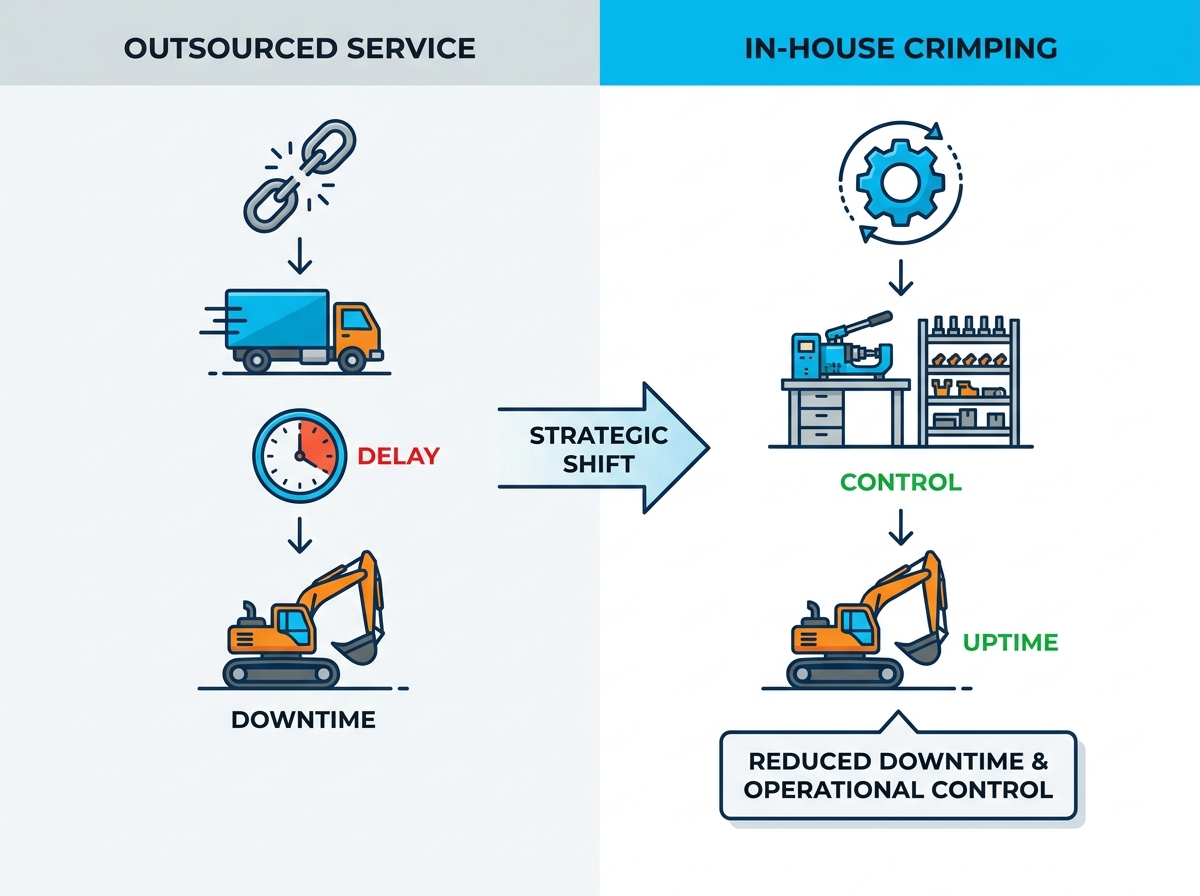
Construction machinery downtime is heavily driven by hydraulic system failures. Every hour an excavator or loader sits waiting for a mobile repair truck compounds project delays. The financial impact of idle operators and missed deadlines adds up rapidly. For mid-to-large heavy equipment fleets, relying strictly on outsourced hose replacement becomes a costly bottleneck. Transitioning to self-assembly and on-site hydraulic hose crimping offers exceptional operational control. You just need the right equipment and solid safety protocols in place.
This article provides fleet managers and maintenance directors with an evidence-based framework. We will help you evaluate, select, and implement an in-house assembly program effectively. You will learn how to bypass reactive dispatch delays and secure long-term productivity. Bringing this capability to your own shop transforms maintenance from a waiting game into a proactive strategy.
Key Takeaways
In-house hydraulic hose crimping reduces equipment downtime by replacing reactive third-party dispatch delays with immediate, on-site assembly.
Selecting the right crimping machine requires matching equipment tonnage and die sets to the specific high-pressure (4-wire and 6-wire) demands of construction machinery.
A successful rollout depends equally on hardware procurement and the strict enforcement of standard operating procedures (SOPs) to mitigate high-pressure safety hazards.
Standardizing hose and fitting inventory is critical; mixing incompatible brands compromises crimp integrity and voids warranties.
The Business Case: Outsourced vs. In-House Hose Crimping
Evaluating the shift toward in-house assembly requires looking closely at downtime costs versus capital expenditure. Relying on third-party mobile mechanics often means paying premium callout fees. You also pay steep markups on individual hoses and fittings. More importantly, you lose valuable machine hours while waiting for dispatch and travel times. A blown boom cylinder line on a 30-ton excavator can halt an entire earthmoving operation.
Upfront costs for a commercial crimping setup and bulk inventory seem significant at first. However, buying hoses by the reel and fittings in bulk provides immediate wholesale savings. You eliminate the labor and travel fees associated with mobile repair services.
Operational control presents a massive strategic advantage. Remote construction sites frequently experience unpredictable response times from external vendors. A self-assembly setup allows your mechanics to fabricate a replacement line immediately. You dictate the schedule, returning the machine to work within minutes rather than hours.
Determining the break-even assessment involves tracking historical failure rates. You must identify how many hose failures your fleet experiences monthly. Compare your average monthly outsourced repair bills against the initial investment of a shop crimper and initial inventory. Fleets experiencing five or more monthly failures typically recover their capital investment within the first year.
Procuring the right hardware requires matching machine capabilities to your specific operational environment. There is no universal solution for heavy machinery maintenance. You must align the equipment category with your mechanics' workflow and mobility requirements.
Mobile/Portable Crimpers
These lightweight units serve field mechanics and service trucks performing on-site emergency repairs. They prioritize portability over maximum power.
Best for: Remote service trucks handling standard pressure lines.
Evaluation criteria: Look closely at weight and power source options. You can choose manual hand pumps, pneumatic pumps, or 12V/24V DC battery-powered units.
Limitations: Their maximum diameter capacity generally caps at 1-inch or 1.25-inch 2-wire hoses. They often lack the pressing force required for heavy spiral hoses.
Shop/Benchtop Crimpers
Benchtop models represent the sweet spot for most construction fleets. They reside in centralized maintenance depots servicing a full fleet. They offer a balance of robust power and manageable footprints.
Best for: Main shop environments handling daily preventative maintenance and walk-in repairs.
Evaluation criteria: High tonnage output is non-negotiable here. These machines typically run on 110V or 220V electric power.
Capabilities: They easily crimp robust 4-wire to 6-wire spiral hoses. These heavy hoses are standard on high-pressure earthmoving equipment like articulated haulers and heavy excavators.
Production-Grade Floor Models
These massive units belong in specialized manufacturing environments or exceptionally large centralized depots. They deliver unparalleled speed and consistency.
Best for: High-volume OEM replacements or regional rebuild centers.
Capabilities: They handle massive industrial hoses and offer rapid, repeatable, high-precision assembly. They feature advanced digital controllers for batch processing. They are overkill for standard fleet maintenance but essential for true mass production.
Core Purchasing Criteria for Heavy Machinery Applications
Buying hardware for construction machinery differs vastly from buying equipment for low-pressure agricultural applications. You must evaluate specific technical thresholds to ensure safety and reliability. A weak crimp on a high-pressure line causes catastrophic blowouts, risking severe injury and equipment damage.
Tonnage and crimp force dictate the machine's absolute capability. You must match the pressing force to the thickest, highest-pressure hoses in your fleet. Construction equipment frequently utilizes 5,000+ PSI hydraulic systems. Crimping heavy 6-wire multi-spiral hoses requires substantial hydraulic tonnage. A machine lacking sufficient force will leave the metal fitting loose, guaranteeing an eventual leak or blowout under load.
Next, assess the die set range and quick-change systems. The efficiency of your mechanics depends on rapid tool changeovers. An ideal machine features a tool-less quick-change mechanism. This allows technicians to swap die sets in seconds without wrestling with pins or specialized wrenches. Ensure the vendor supplies a comprehensive range of interchangeable dies covering all your standard hose diameters.
Calibration and micro-adjustment capabilities represent critical safety features. Evaluate the machine's micrometer or digital controller for precision. Mechanics must adjust the final crimp diameter to exact factory specifications. A digital controller offers repeatable accuracy, preventing under-crimping or over-crimping. Over-crimping crushes the inner tube, creating flow restrictions. Under-crimping allows the fitting to detach under pressure.
Finally, understand system compatibility and the risks of the "mix-and-match" approach. You must procure equipment engineered for specific hose and fitting tolerances. Hose manufacturers design their hoses, fittings, and crimp specifications as a unified system. Mixing one brand of hose with another brand of fitting compromises the engineered bite. This practice voids manufacturer warranties and exposes your company to severe liability if a failure causes personal injury.
Standard Operating Procedures (SOPs) & Safety Compliance
Hardware alone cannot guarantee a successful in-house program. Strict adherence to standard operating procedures keeps your mechanics safe and your machinery operational. Hydraulic systems store immense energy. Improper techniques introduce extreme hazards to the workshop environment.
Hazard mitigation must remain your top priority. You must recognize the severe risks of high-pressure injection injuries. These injuries occur when a failing crimp releases a pinhole stream of hydraulic oil under extreme pressure. The oil pierces human skin easily, injecting toxic fluid deep into tissues. This requires immediate surgical intervention. Proper crimping techniques and perfectly calibrated machines prevent these structural failures entirely.
Establish mandatory Personal Protective Equipment (PPE) and workspace requirements. Baseline safety protocols for the crimping station are non-negotiable.
Mechanics must wear shatterproof eye protection at all times during operation.
Heavy-duty leather gloves protect hands from sharp wire braids during cutting and insertion.
The workspace must remain well-lit, uncluttered, and strictly designated for hose assembly.
Implementing a rigorous Quality Assurance (QA) protocol ensures every hose meets OEM standards. Document a standardized inspection process for every single assembly. Mechanics must use specialized digital calipers to verify the final crimp diameter. They must check this measurement against the manufacturer's official specification charts before deploying the hose to the machine. A visual inspection is never sufficient.
Routine machine maintenance preserves your investment and ensures ongoing accuracy. Establish a scheduled SOP for basic upkeep. Mechanics must regularly grease the crimper cone using specialized high-pressure molybdenum grease. They should inspect all dies for metal flaking, cracking, or severe wear. Finally, verify the hydraulic fluid levels in the pump periodically to maintain optimal pressing force.
Implementation: Rollout Strategies for Maintenance Teams
Deploying a new capability across a maintenance department requires a structured approach. Throwing a machine into the parts room without a plan guarantees chaos. A strategic rollout builds confidence and ensures consistent quality across all shifts.
Begin with comprehensive technician training programs. Do not limit training to basic button-pushing. Move beyond simple operation to train mechanics on critical preparation steps. Teach proper hose routing to prevent premature abrasive wear on the machine. Train them on skiving techniques, which involves stripping the outer rubber cover to allow a metal-to-metal bite on high-pressure fittings. Mechanics must also learn how to identify and mark proper insertion depths. If a hose is not pushed fully into the fitting before crimping, the assembly will fail.
Inventory management dictates the speed of your assembly process. Structure the parts room to support the crimper logically.
Organize bulk hose reels horizontally on dispensing racks to prevent tangling.
Sort matched fittings, ferrules, and flanges in clearly labeled bins.
Implement a strict closed-bin policy to prevent dust and metal shavings from contaminating the hydraulic components.
Adopt a pilot testing strategy for a smoother transition. We recommend a phased rollout. Start by installing a benchtop unit in the main shop for standard preventative maintenance tasks. Allow the team to build proficiency in a controlled environment. Once quality metrics stabilize, you can begin equipping field trucks with portable units for emergency response. This phased approach minimizes initial errors and builds internal expertise naturally.
Conclusion
Bringing your hose assembly processes in-house stands as a major strategic advantage. It pays massive dividends in machinery uptime, effectively eliminating the friction of third-party dispatch delays. Success requires a commitment to proper equipment sizing and an unwavering dedication to standard operating procedures. By avoiding the mix-and-match trap and prioritizing safety, you regain total control over your fleet's maintenance schedule.
To begin, audit your fleet's most common hose failures. Document the sizes, pressure ratings, and fitting styles your machines consume most frequently. Use this data to draft a highly accurate equipment specification sheet for your shop.
If you need assistance analyzing your fleet requirements, contact us to consult with our technical specialists. We can help match the ideal machine configuration to your specific heavy equipment maintenance demands.
FAQ
Q: Can I use any brand of fittings with my hydraulic hose crimping machine?
A: No. Mixing manufacturers introduces severe safety risks. Dies, hoses, and fittings function together as an engineered system with highly specific tolerances. Using mismatched brands compromises the structural integrity of the crimp, voids all manufacturer warranties, and drastically increases the risk of high-pressure blowouts.
Q: How often does a hydraulic hose crimper need to be calibrated?
A: You should check calibration daily or weekly, depending on your shop's production volume. Use high-precision digital calipers to measure a test crimp. Compare this exact diameter against the manufacturer's specification chart to ensure the machine is applying the correct pressing force.
Q: Do I need a skiving machine to crimp hoses for construction equipment?
A: It depends entirely on the specific hose and fitting type you use. While many modern "no-skive" solutions exist for medium pressures, high-pressure multi-spiral hoses (4-wire and 6-wire) often require skiving. This removes the outer rubber cover, ensuring a secure metal-to-metal bite essential for heavy machinery.
Q: What is the maximum hose size a portable crimper can handle?
A: Portable and mobile units typically max out at 1-inch or 1.25-inch 2-wire hoses. Due to size and power constraints, they generally struggle with the heavy 4-wire or 6-wire multi-spiral hoses used on the main boom cylinders of large excavators.
Handanshi Kangmai Hydraulic Equipment Co., Ltd. is located in the east of Wangzhuang,on the Hanlin expressway. Our main products have 9 series and 50 types which contains hose crimping machine, hose cutting machine,hose skiving machine...