
Views: 0 Author: Site Editor Publish Time: 2026-06-04 Origin: Site


A failing hydraulic hose connection leads directly to system downtime. It causes immediate fluid loss and creates severe safety hazards on the floor. The long-term reliability of your connection depends entirely on the specific crimping equipment you deploy. Facility managers face tough equipment choices daily. Hydraulic repair technicians and OEM production lines must decide between manual and automatic systems. This choice represents a critical operational decision for your entire team. You must balance upfront capabilities against long-term assembly repeatability.
We built this comprehensive guide to help you navigate these complex choices. Our breakdown explores technical capabilities, operational limits, and daily production criteria. You will learn exactly how to determine which technology aligns with your current production volume. We will show you how to match equipment to your unique mobility requirements. You will also discover how to maintain strict industry safety standards while optimizing your workflow.
Volume dictates technology: Automatic machines are required for high-volume, repeatable OEM production, while manual machines serve low-volume or sporadic field repairs.
Precision vs. Skill: Automatic models remove human error and operator fatigue, ensuring consistent crimp diameters; manual models rely heavily on the operator's physical consistency and skill.
Mobility limits: Manual crimpers offer unmatched portability for on-site machinery repairs without relying on an external power source.
Total Cost of Ownership (TCO): While manual machines have a lower entry price, automatic machines yield a faster ROI in high-volume settings through reduced labor time and lower scrap rates.
Understanding the mechanical foundation of a hose crimping machine helps you make better procurement choices. Both manual and automatic systems share the same fundamental goal. They compress steel dies around a metal fitting to secure it permanently to a rubber hose. However, they achieve this goal using vastly different power delivery methods. Below, we explore the distinct operational mechanics of each system.
Manual systems rely entirely on human physical effort to generate hydraulic pressure. The operator utilizes a hand-operated or foot-operated pump lever. Each stroke pushes hydraulic fluid into a primary cylinder. This fluid pressure gradually forces the pusher plate down onto a set of tapered dies. The dies then compress uniformly around the hose fitting. Operators must visually monitor the process and measure the final diameter manually.
These units excel in rugged environments. They function perfectly in remote agricultural fields or deep inside mining sites. Service technicians mount them inside mobile service trucks. Small DIY shops use them for occasional repairs. They require zero external electricity. You can carry a manual unit directly to a broken excavator in the mud. However, they demand significant physical stamina from the operator.
Best Practices: Always keep the hydraulic pump breather valve clean. Dirt ingress ruins manual pump seals rapidly in field environments.
Common Mistakes: Technicians often forget to verify the final crimp diameter using a calibrated micrometer. You cannot rely on "feel" alone.
Automatic systems replace physical labor with an electric motor. The motor drives a heavy-duty hydraulic pump. Digital keypads, touchscreens, or simple foot pedals control the entire compression cycle. You program the target crimp diameter into the digital controller. The machine automatically advances the dies, hits the exact diameter, and retracts independently. This automation guarantees pinpoint accuracy across hundreds of assemblies.
These sophisticated units dominate high-capacity assembly shops. Industrial manufacturing lines rely on them exclusively. Scenarios demanding strict ISO or SAE compliance require automated consistency. The digital controller eliminates human guesswork. Operators simply load the hose, press a button, and wait a few seconds. The machine handles the heavy lifting.
Best Practices: Save frequent hose specifications into the machine's digital memory to speed up daily changeovers.
Common Mistakes: Operating the machine without properly greasing the die cone leads to severe metal galling and inaccurate crimps.
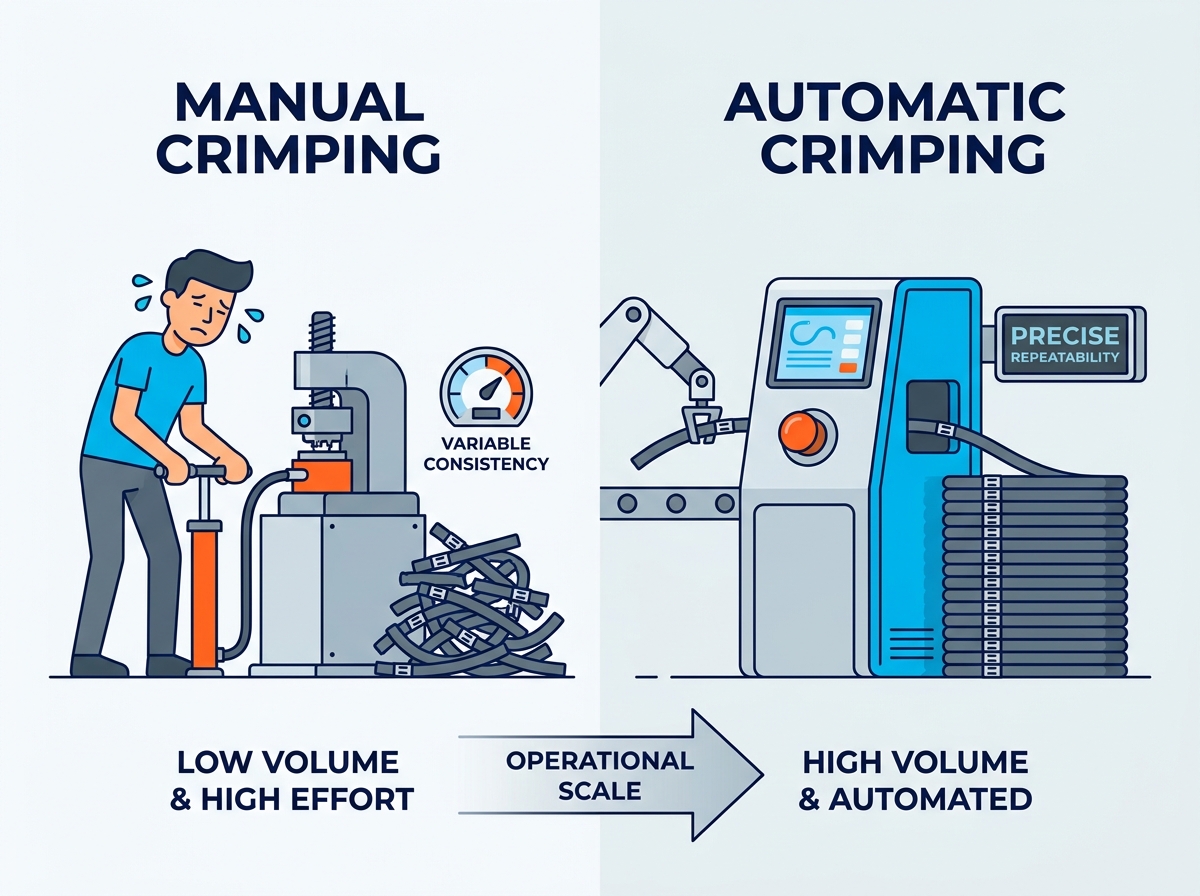
You must evaluate equipment across multiple operational dimensions. A machine might look perfect on paper but fail completely in your specific work environment. We break down the four critical performance criteria below. This analysis helps you align machine capabilities with your daily workflow realities.
Cycle time directly impacts your daily output capacity. Automatic machines complete a full crimp cycle in three to five seconds. The operator presses a single button. The machine rapidly advances, crimps, and retracts. You can process hundreds of hose assemblies per shift effortlessly. This speed proves essential for OEM suppliers and busy retail hydraulic shops.
Manual machines operate at a much slower pace. A single assembly might require thirty to sixty seconds of continuous pumping. The operator must physically push the lever up and down multiple times. This repetitive motion causes significant operator fatigue. After assembling just five or six hoses, physical exhaustion sets in. Productivity drops sharply. Manual tools simply cannot support high-volume manufacturing environments.
Performance Metric |
Manual Systems |
Automatic Systems |
|---|---|---|
Average Cycle Time |
30 - 60 seconds |
3 - 5 seconds |
Daily Volume Capacity |
Low (1-20 hoses) |
High (100+ hoses) |
Operator Fatigue |
Very High |
Minimal |
Power Dependency |
None (Self-contained) |
Requires 110V/220V/3-Phase |
Safety depends entirely on crimp precision. A loose fitting causes catastrophic leaks under high pressure. A crushed fitting fractures internally and blows off the hose. Automatic machines utilize digital controllers and internal position sensors. They stop exactly at the programmed diameter every single time. This automated consistency drives scrap rates down to near zero. Every hose leaves the shop meeting strict safety tolerances.
Manual operations introduce significant human variables. The operator must watch an indicator gauge or rely on a physical stop switch. They must then measure the completed fitting using a micrometer. If the operator loses focus, they risk under-crimping or over-crimping the fitting. Physical fatigue further degrades their precision. Manual systems require meticulous attention to detail for every single connection.
Portability often dictates your equipment choice in the heavy equipment industry. Manual machines function as standalone units. You can bolt them to a truck tailgate. You can carry them directly to a broken forestry machine. They require no generators, extension cords, or specialized wiring. This total independence makes them mandatory for mobile emergency repair fleets.
Automatic machines sacrifice mobility for raw power. They weigh hundreds of pounds. They feature large electric motors requiring specific voltages. You cannot easily move them around a shop, let alone take them into the field. They require a controlled workshop environment. You must secure dedicated electrical circuits to power them safely. Their stationary nature limits them to fixed production layouts.
Equipment complexity dictates your training timelines. Automatic machines feature a steeper initial learning curve for programming. Operators must learn how to navigate touchscreen menus. They must understand how to input offset values and save recipes. However, once programmed, the physical operation requires almost zero skill. The machine executes the physical work flawlessly.
Manual machines require minimal technical programming. The training focuses heavily on physical technique. Operators develop a "feel" for the pump resistance. They must learn exact body positioning to maximize pumping leverage. More importantly, they must master manual measurement techniques. Training a manual operator to produce consistent, safe hoses actually takes longer due to the physical variables involved.
Buying the wrong equipment creates immediate operational bottlenecks. Many facilities make critical procurement errors by ignoring their actual environmental constraints. You must anticipate these adoption challenges before finalizing your equipment purchase.
Many service managers mistakenly purchase bulky automatic machines for mobile service vans. This over-specification creates major headaches. An automatic machine requires substantial electrical power. A standard van inverter rarely provides enough startup amperage for an industrial motor. You end up carrying a heavy, unusable piece of equipment. The machine takes up valuable payload space. You also expose sensitive digital controllers to harsh weather, vibration, and dust.
Verify your mobile generator capacity before buying motorized equipment.
Consider environmental exposure limits for touchscreens in field trucks.
Budget constraints often tempt managers to buy manual machines for busy workshops. This under-specification destroys productivity. Trying to process fifty hoses a day using a hand pump exhausts your workforce. Operators will cut corners due to fatigue. They will skip micrometer verification steps. Inconsistent product quality becomes inevitable. Your scrap rates will climb rapidly. Ultimately, the cost of wasted fittings and blown hoses eclipses the initial equipment savings.
Industrial automatic units demand specific infrastructure. You cannot simply plug a three-phase industrial machine into a standard wall outlet. Facility managers often overlook electrical verification during the procurement phase. The machine arrives, but the shop lacks the correct voltage or phase power.
Audit your electrical panel before ordering any automatic equipment.
Verify you have dedicated breakers to handle high startup loads.
Measure your bench space to ensure the heavy machine fits safely.
Plan for proper lighting around the crimping station to aid visual inspection.
Selecting your ideal setup requires an honest audit of your daily workflow. Do not purchase equipment based solely on feature lists. Let your actual operational data drive the final decision. Use the framework below to categorize your specific needs.
Manual systems fit perfectly into specific, low-volume niches. You should strongly consider a manual setup if your operation matches these criteria. First, your team averages fewer than ten to fifteen hose assemblies per week. Second, your primary operations take place in remote locations. You fix machinery in agricultural fields, mining pits, or construction sites. You lack reliable access to electrical grids or heavy generators. Finally, operational speed does not impact your bottom line. You prioritize the ability to make a repair anywhere over the speed of that repair.
High-volume operations demand automated solutions. Shortlist an electric or electro-hydraulic system if you process daily high-volume assemblies. OEM suppliers, busy retail hydraulic shops, and heavy manufacturing plants fall into this category. You require strictly documented, highly repeatable crimp specifications to meet safety compliance standards. You want to scale your business output. You need to double your production volume without doubling your manual labor hours. Automatic systems provide this exact scalability.
Some operations fall right in the middle. You need mobility, but you want to eliminate operator fatigue. You can explore a hybrid approach using pneumatic (air-over-hydraulic) pumps. These units connect to a standard air compressor on a service truck. They provide automated pumping without needing high-voltage electricity. Battery-operated portable crimpers also offer a modern middle ground. They utilize heavy-duty power tool batteries to drive the hydraulic pump. They bridge the gap between complete mobility and reduced manual labor.
The choice between a manual and an automatic system is not about finding an objectively superior technology. It involves finding the exact equipment profile that aligns with your daily workflow. Manual units dominate the remote field repair industry. Automatic machines serve as the backbone of high-volume manufacturing facilities. Your environment dictates your requirements.
We recommend evaluating your historical daily assembly volume first. Review your primary repair locations carefully. Let actual production data drive your final procurement decision. Factor in operator fatigue, electrical infrastructure, and mobility constraints before making a purchase.
Consult with an equipment specialist to audit your current workflow. They can help you calculate cycle times and verify facility requirements. Reach out today to find the perfect hose crimping machine for your exact operational needs. Proper equipment selection ensures maximum safety and operational efficiency for years to come.
A: Yes. Provided the operator follows exact die selection guidelines and meets the specified crimp diameter, the final connection holds identical pressure. The true difference lies in repeatability and speed, not the maximum pressure capability of the individual assembly.
A: Industry experts generally recommend calibrating your machine annually. You should also calibrate it after hitting specific cycle milestones, such as 10,000 crimps. Always follow your specific manufacturer’s baseline recommendations to ensure consistent accuracy and maintain your warranty coverage.
A: Typically, no. You can sometimes swap a manual hand pump for a pneumatic air-over-hydraulic pump to save physical labor. However, true automatic machines feature integrated digital controllers, sensors, and specialized manifolds. You cannot retrofit these complex electronic components onto a basic manual frame.


