Equipment downtime drains profits rapidly in fluid power operations. Heavy machinery stops instantly when a hydraulic line blows. Your entire project timeline depends entirely on reliable hose assemblies. Replacing broken lines quickly remains vital for keeping operations profitable. Choosing the right hose crimping machine rarely involves finding a universally superior model. Instead, you must match the equipment's duty cycle and physical footprint to your daily operational realities. You might need on-site emergency repair capabilities. Alternatively, you might run a high-volume shop production line. Each scenario demands highly specific machine capabilities. We break down the technical limitations and implementation realities of both portable and stationary models below. You will learn how to evaluate pressure ratings, volume requirements, and power accessibility. This guide helps buyers make a qualified purchasing decision based on operational facts.
Key Takeaways
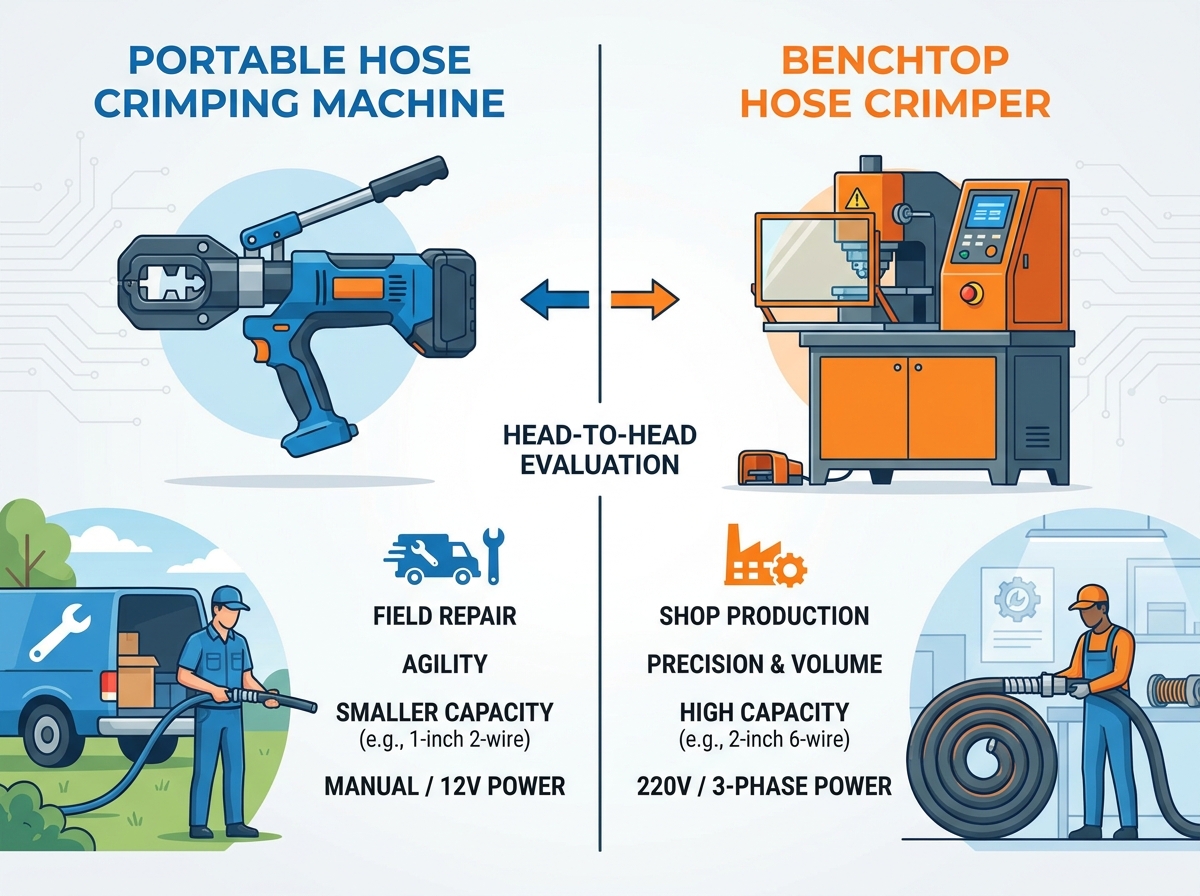
A portable hose crimping machine is built for agility and emergency field repairs, ideal for minimizing mobile equipment downtime but limited by smaller hose diameter capacities.
A benchtop hose crimper is the standard for OEMs and dedicated repair shops, offering high precision, programmable repeatability, and the power to crimp multi-spiral hoses up to 2 inches or more.
The primary decision drivers are daily crimp volume, required hose specifications (diameter and pressure ratings), and available power sources (manual/12V vs. 220V/3-phase).
Over-specifying leads to wasted capital, while under-specifying risks weak crimps, potential blowouts, and safety hazards.
Defining Your Operational Baseline: Field Service vs. Shop Production
You must shift your focus from the machine itself to your actual operational bottlenecks. Business owners often buy equipment based on impressive specifications. However, they ignore how the tool fits into their daily workflow. You need to ask yourself where you lose the most money. Are you bleeding cash because field repairs take hours? Or do slow assembly outputs bottleneck your retail shop?
Defining success looks different for every business. A field service technician views success as achieving a fast, 5-minute repair turnaround in the mud. They want to get an excavator running before the next shift starts. Conversely, shop managers view success through the lens of volume. They want to produce 100 identical assemblies per hour without stopping. You cannot achieve both outcomes efficiently using the same exact machine.
Misaligning your equipment choice creates severe compliance and safety risks. Hydraulic systems routinely operate at pressures exceeding 5,000 PSI. You run extreme risks if you use an underpowered machine to crimp high-pressure, multi-wire hoses. The machine might lack the necessary tonnage to deform the metal fitting properly. Faulty crimp specifications lead directly to catastrophic hydraulic fluid leaks. These failures endanger workers, damage expensive machinery, and expose your company to massive liability claims. You must secure a machine capable of meeting strict SAE (Society of Automotive Engineers) guidelines for fluid power systems.
The Portable Hose Crimping Machine: Capabilities and Implementation Risks
Mobile crimpers provide essential agility for breakdown sites. Manufacturers design these compact tools specifically for travel. They utilize hand-pumps, pneumatic air over hydraulic systems, or 12V/24V battery-operated motors. Technicians load them into service trucks and carry them directly to broken machinery. You bring the repair to the problem.
This design offers several distinct performance advantages. First, you gain zero reliance on grid power. You can rebuild a busted line in the middle of a remote forestry site. Second, a portable hose crimping machine delivers immediate return on investment. It eliminates the need to transport broken heavy machinery back to a depot. You also avoid waiting hours for a courier to deliver an off-site hose. Finally, the compact footprint takes up minimal space in crowded utility trucks.
However, you must accept certain implementation realities and limitations. Portable units carry a strict capacity cap. They typically max out at 1-inch or 1¼-inch 2-wire braided hoses. They simply lack the crushing force required for 4-wire or 6-wire spiral hoses. Furthermore, you sacrifice speed. Manual pumping or low-voltage motors result in much longer cycle times per crimp. You also introduce operator dependency. A hand-pump system makes it much harder to guarantee micro-millimeter precision. Shop machines automate this precision.
The ideal buyer profile for these mobile units remains highly specific. Mobile mechanics depend on them daily. Agricultural repair technicians use them in remote fields. Forestry operations and heavy civil construction fleets consider them mandatory inventory. If your business revolves around getting stranded assets moving quickly, portability wins.
The Benchtop Hose Crimper: Scalability, Precision, and Volume
Stationary shop crimpers serve as the heavy-duty backbone of fluid power businesses. Manufacturers build these machines for permanent installation on workbenches or retail counters. They draw immense power from 110V, 220V, or 3-phase electric networks. You install them once and let them dictate your shop layout.
A benchtop hose crimper delivers massive performance advantages. High capacity stands out immediately. These units easily handle high-pressure 4-wire and 6-wire hydraulic hoses up to 2 inches in diameter and beyond. They generate enough tonnage to crush thick steel fittings effortlessly. Repeatability serves as another massive advantage. Digital controllers and programmable keypads ensure exact crimp diameters every single time. They remove human operator guesswork entirely. Throughput also skyrockets. Operators use quick-change die systems to swap sizes in seconds. Rapid cycle times allow you to execute high-volume OEM production seamlessly.
Despite their power, these machines carry distinct implementation limits. Inflexibility remains the biggest hurdle. You must bring the broken hose directly to the machine. You cannot easily drag a 300-pound crimper into a field. Additionally, they demand strict setup requirements. You must allocate dedicated, reinforced bench space. You need specific voltage or phase electrical drops installed by licensed electricians. You must also perform routine calibration to maintain digital accuracy over thousands of cycles.
The ideal buyer profile favors stationary environments. Hydraulic repair shops form the primary market. Heavy equipment maintenance bays install them to service their own fleets. Manufacturing plants and OEM assembly lines depend on them for constant daily output. If you build hoses in bulk or service massive industrial equipment, stationary power is non-negotiable.
Head-to-Head Evaluation: 4 Dimensions of a Qualified Decision
Hose Specifications (Diameter & Pressure)
You must evaluate your toughest hose first. Machine tonnage dictates what you can physically crimp. Wire braided hoses require far less force than multi-wire spiral hoses. You should match the machine's pressing force to the maximum diameter and pressure rating you handle. Do not buy a lightweight machine if your fleet relies heavily on 1½-inch 6-wire spiral hoses. It will fail to achieve the required fitting compression.
Power Source Accessibility
You must assess your working environment realistically. A high-tonnage stationary machine becomes entirely useless without access to stable 3-phase power. It cannot operate in a mobile setting. Conversely, mobile units offer immense flexibility but require physical labor. You must either manually pump them or supply compressed air from a service truck compressor. You need to verify exactly what power sources you can guarantee before purchasing.
Production Volume and Duty Cycle
You must differentiate your daily workflow volume clearly. Making "5 emergency hoses a week" demands a drastically different tool than making "50 customized assemblies a day." High-volume production generates significant heat. The hydraulic oil inside the machine gets hot quickly. Stationary units feature large fluid reservoirs designed to dissipate this heat during continuous use. Portable units feature tiny reservoirs. They risk overheating rapidly under continuous use.
Tooling and Long-Term Versatility
You must factor in the compatibility of die sets. High-capacity machines often accommodate a much wider array of specialized dies. This expands your ability to service different industries. You can switch from industrial water hoses to extreme-pressure hydraulic lines easily. Stationary units maximize your service capabilities over the long term. Mobile units restrict your versatility to standard, smaller-diameter fittings.
Decision Factor
Portable Models
Benchtop Models
Primary Location
On-site, remote fields, service trucks
Retail shops, OEM floors, maintenance bays
Max Capacity (Typical)
1" to 1¼" (2-wire braided)
2" and above (4-wire/6-wire spiral)
Power Requirements
Manual pump, pneumatic, 12V/24V
110V, 220V, or 3-Phase Electric
Duty Cycle
Low volume / intermittent repair
High volume / continuous production
Precision Control
Manual micrometer / operator dependent
Digital keypad / fully programmable
Shortlisting Logic: How to Choose Your Hose Crimping Machine
You can follow a strict logic path to eliminate the wrong choices quickly. Equipment buyers often skip these foundational steps. They buy a machine based on price alone and regret it later. Use this five-step framework to narrow down your options securely.
Audit your current hose inventory. Look at the layline printed on your hoses. Identify your largest diameter hose. Next, identify the highest-pressure hose you service. Your chosen machine must handle this worst-case scenario easily.
Map the repair location. Determine where the majority of your assemblies fail. Is the equipment highly mobile and hard to transport? Or do customers bring the blown lines into your shop? Location dictates your required mobility.
Calculate volume requirements. Determine acceptable cycle times based on daily output. If you make one hose a day, a 60-second manual pump cycle works fine. If you make 100 a day, you need a 5-second automated cycle.
Verify compatibility. Ensure your chosen machine supports the specific hose and fitting brands you use. Mixing unmatched fittings, hoses, and crimp specifications violates fundamental safety standards. It causes blowouts.
Execute the next-step action. Stop guessing. Request technical specification sheets. Review die-set compatibility lists carefully. Ask manufacturers to provide a demo or sample crimp video. Discussing your needs directly ensures perfect alignment.
Following this logic removes emotional buying. It forces you to look objectively at your operation. Once you complete these steps, you are ready to explore purchasing options for a reliable hose crimping machine.
Conclusion
Neither equipment category proves universally superior. The best choice depends entirely on your daily operational realities. A mobile unit buys you supreme agility. It allows you to rescue stranded heavy machinery immediately. A stationary machine buys you massive capacity and unbreakable consistency. It turns your shop into a high-output production center.
For scaling fluid power businesses, the ultimate goal often involves a strategic hybrid approach. Many successful operations install a heavy-duty stationary machine in the main shop. They then equip their primary service truck with a mobile unit. This covers every possible breakdown scenario.
We encourage you to document your specific hose sizes, fitting types, and daily volume requirements today. Contact a technical sales engineer with this data. They will provide a tailored equipment recommendation that perfectly matches your exact operational constraints.
FAQ
Q: Can a portable hose crimping machine handle 4-wire hydraulic hoses?
A: Generally, yes, but only within strict limits. Most mobile units lack the tonnage to compress large spiral hoses. They restrict you to smaller diameters, typically maxing out at 1-inch for 4-wire hoses. You will struggle to achieve safe, compliant compression on anything larger without stationary power.
Q: Are die sets interchangeable between portable and benchtop models?
A: Usually, they are not interchangeable. Manufacturers design specific tooling profiles for specific machine heads. A massive stationary unit uses physically larger dies to distribute higher pressing forces. You must purchase dedicated die sets designed exclusively for your specific machine model.
Q: What maintenance is required for a benchtop hose crimper?
A: These machines require consistent preventative maintenance. You must regularly grease the cone and dies with high-pressure molybdenum grease. You need to check hydraulic fluid levels monthly and change the oil annually. Finally, you must perform annual digital calibration to ensure the crimp diameters remain perfectly accurate.
Q: Is it cheaper to buy pre-made hoses or invest in a crimping machine?
A: Investing in equipment yields an incredibly fast ROI if your machinery breaks down frequently. Pre-made hoses cost more per unit and force you to wait for delivery. An in-house machine eliminates costly hourly downtime. Getting an excavator back to work instantly easily pays for the equipment.
Handanshi Kangmai Hydraulic Equipment Co., Ltd. is located in the east of Wangzhuang,on the Hanlin expressway. Our main products have 9 series and 50 types which contains hose crimping machine, hose cutting machine,hose skiving machine...