
Views: 0 Author: Site Editor Publish Time: 2026-05-25 Origin: Site


The stakes in hydraulic and industrial fluid conveyance assembly remain incredibly high across all manufacturing sectors. A single failed crimp easily causes catastrophic equipment failure on the job site. It creates severe environmental safety hazards and triggers immensely frustrating operational downtime. You simply cannot afford to guess when securing high-pressure fittings.
Generic equipment overviews rarely help facility managers during the actual evaluation and procurement stage. Modern manufacturing equipment varies wildly in core capabilities. You will find everything from basic field-service hand pumps to high-volume, fully automated workshop units. Navigating these options requires a deep understanding of your specific production environment.
To maximize operational returns and ensure long-term reliability, procurement teams must rigorously evaluate an industrial hose crimping machine based on highly precise performance thresholds. You must look for verifiable control systems and strict safety compliance. We will explore how to look past surface-level marketing claims. This guide helps you pinpoint the exact equipment your manufacturing operation truly needs.
Capacity vs. Reality: Always size crimping force based on your toughest assemblies (e.g., multi-wire spiral hoses), not just your average daily output.
Control Equals Consistency: Digital controllers and quick-change die systems dramatically reduce operator error and material scrap rates compared to manual dials.
Safety is Non-Negotiable: Advanced safety features—such as guarded foot pedals, emergency stops, and die-insertion safeguards—are critical for OSHA compliance and operator protection.
TCO Over Initial Price: Long-term value relies heavily on ease of calibration, availability of replacement die sets, and vendor technical support.
Buying the wrong equipment creates instant production bottlenecks. High scrap rates erode your profit margins almost immediately. Inadequate machines ultimately prevent you from scaling production effectively. You must frame your equipment purchase around specific business problems. First, identify your biggest operational hurdle today. Are operators taking too long to set up specific profiles? Do you experience too many failed assemblies out in the field? Answering these questions narrows your focus immediately and sets a clear baseline for success.
Next, look closely at your production volume mapping. Low-volume, high-mix environments demand extreme tooling flexibility. You might build a small thermoplastic assembly followed immediately by a massive heavy-duty spiral hose. This setup needs rapid changeovers and highly versatile tooling components. Conversely, high-volume, low-mix environments focus entirely on repetition. You might produce thousands of identical assemblies daily. This scenario requires deep automation integrations. It also demands robust thermal management to handle relentless, non-stop cycles.
Adopt a highly skeptical lens during the procurement process. Ignore broad "one-size-fits-all" promises from equipment manufacturers. A machine optimized for portable field repair is inherently light and significantly slower. It will inevitably fail if pushed into a three-shift continuous industrial production schedule. Match the machine's core engineering intent exactly to your daily operational reality.
Crimping force, usually measured in overall tonnage, dictates your machine's true operational ceiling. You must thoroughly evaluate tonnage requirements based on your most extreme applications. Securing standard two-wire braided hoses requires relatively modest hydraulic force. However, heavy-duty four-wire or six-wire spiral industrial hoses demand massive hydraulic pressure to deform the steel collar properly. If you underestimate this basic requirement, you risk incomplete compressions and incredibly dangerous blown fittings.
You must always perform a strict assumption check on manufacturer diameter claims. Maximum hose diameter specifications often assume ideal, light-duty conditions. Always verify the machine's capability on the largest advertised diameter specifically at its maximum wire layers. A machine claiming a two-inch capacity might only handle two-inch single-wire hoses. It will likely stall completely on two-inch six-wire variants.
Hose Construction Type |
Typical Diameter Range |
Recommended Minimum Force |
Primary Application Scenario |
|---|---|---|---|
Standard 1-Wire / 2-Wire Braid |
1/4" to 1-1/4" |
120 - 150 Tons |
General manufacturing, medium-pressure hydraulics |
Heavy-Duty 4-Wire Spiral |
3/4" to 2" |
240 - 280 Tons |
Construction machinery, heavy agricultural equipment |
Extreme 6-Wire Spiral |
1-1/4" to 3" |
340+ Tons |
Mining operations, deep forestry equipment |
Carefully evaluate the overall metallurgy of the supplied die sets. Hardened tool steel resists severe wear over thousands of intense compression cycles. Look for equipment offering comprehensive, easily expandable die ranges. Your production needs will evolve over time. Your machine should accommodate new profiles seamlessly without requiring a completely new base unit.
Quick-change functionality delivers enormous daily business value. Operators frequently waste valuable time wrestling with individual die segments manually. Reducing a full die-swap from five minutes to thirty seconds directly lowers your labor expenses. In high-mix environments, this single mechanical feature dramatically boosts your daily output metrics.
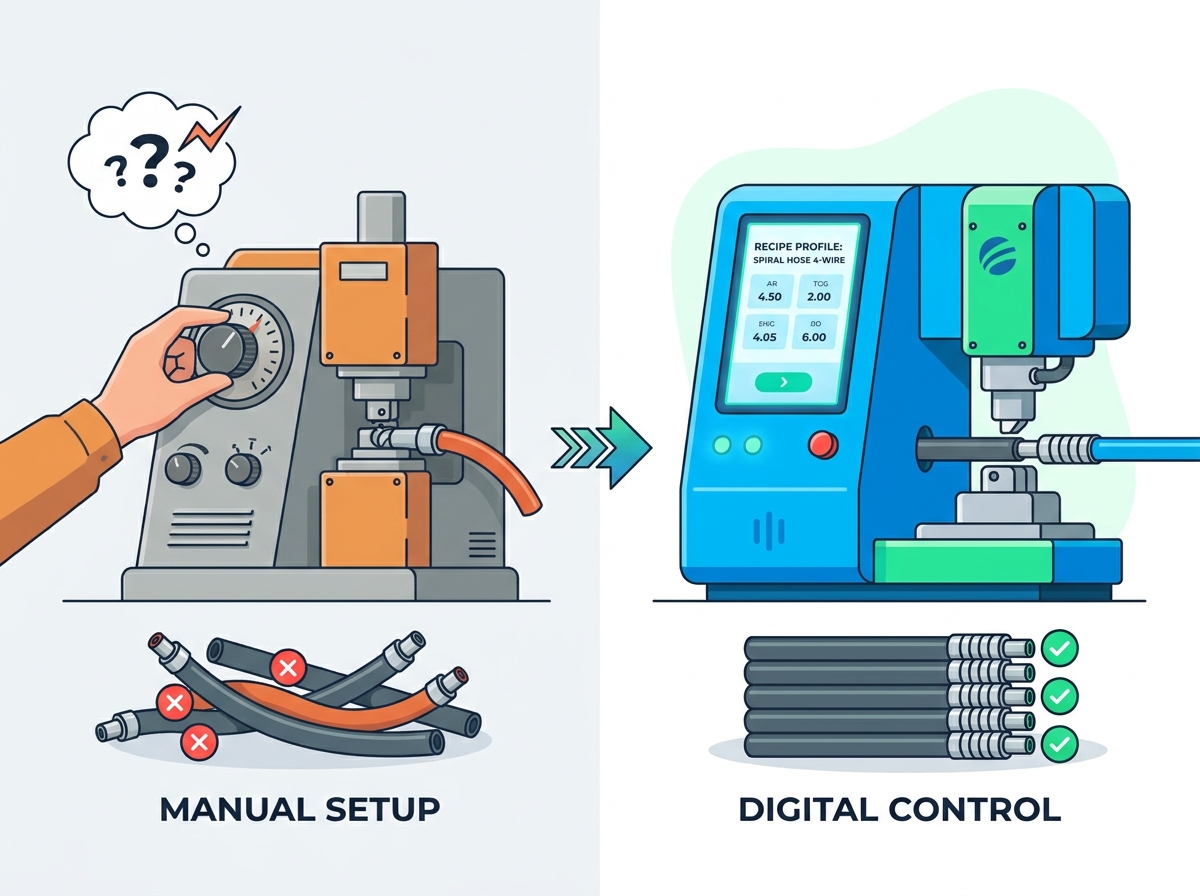
The industry is rapidly shifting away from outdated manual micrometers. Digital touchscreens and Programmable Logic Controller (PLC) systems represent the new manufacturing standard. Manual dials require frustrating trial, error, and constant operator adjustment. This opens the door wide for significant human error. Digital systems allow you to save specific crimp recipes directly into the machine's internal memory. Operators simply select a saved profile. This eliminates dangerous guesswork completely.
Adjustable retraction limits drastically speed up your daily cycle times. During continuous production, you do not want dies opening fully between each insertion. Modern controllers let you restrict exactly how far dies retract. They open just enough to release the completed assembly safely. This prevents wasted mechanical movement and dramatically accelerates consecutive cycles.
Quality assurance integrations elevate a basic machine into an advanced manufacturing asset. High-end units feature built-in pressure transducers. These highly sensitive sensors measure the exact radial force applied during every single cycle. Automated diameter verification systems flag out-of-tolerance assemblies immediately. They stop defective parts before they ever leave the shop floor, ensuring strict compliance with ISO and SAE standards.
Rigorous safety features protect your workforce and ensure strict regulatory compliance. Actuation controls sit at the forefront of this operator protection. Guarded, two-stage foot pedals are an absolute necessity for any serious facility. They keep the operator’s hands entirely free to manipulate heavy, awkward assemblies safely. The physical guard prevents falling objects or accidental bumps from triggering the hydraulic mechanism.
Emergency stops (E-Stops) and Lockout/Tagout (LOTO) capabilities remain completely mandatory. Verify the presence of highly visible, easily accessible E-stops positioned strategically around the workstation. Strict compliance with standard industrial safety protocols heavily protects your maintenance teams. Energy isolation points must be clear, functional, and easily lockable.
Operators absolutely need a clear line-of-sight to properly seat the fitting inside the mechanism. However, facility managers must balance this visibility meticulously with physical guarding. Well-designed shields prevent catastrophic pinch-point injuries. They block hands from entering the active danger zone without obscuring the operator's view of the final closing process.
Train all new operators specifically on the digital controller interface before allowing live production runs.
Test all emergency stops weekly to ensure immediate and total hydraulic cutoff.
Never bypass physical guards to speed up awkward or unusual hose insertions.
Implement strict daily visual inspections of all hydraulic hoses leading into the machine itself.
Mobile and field service models excel only in highly specific, limited scenarios. Evaluate their portability features very carefully. Consider overall weight, integrated carrying handles, and versatile power sources. Field units run efficiently on manual hand pumps, pneumatic lines, or 12V/24V battery systems. However, field machines carry inherent risks. They trade precision, cycle speed, and raw force for crucial mobility. They serve as emergency repair tools, not primary factory replacements.
Stationary workshop models handle the heavy lifting for ongoing manufacturing. Focus your evaluation heavily on footprint and operator ergonomics. A proper working height prevents severe operator fatigue during demanding eight-hour shifts. These robust units utilize continuous-duty electric motors built specifically for heavy, uninterrupted workloads.
Thermal management becomes highly critical in these stationary environments. Machines running high-frequency cycles generate immense internal friction and heat. Evaluate integrated oil coolers and overall reservoir capacities carefully. Proper cooling prevents hydraulic fluid viscosity breakdown. It ensures consistent clamping pressure and significantly prolongs the lifespan of expensive internal pump seals.
Long-term operational value relies heavily on basic, everyday maintenance requirements. Examine the manufacturer's greasing protocols carefully. Does the unit feature advanced self-lubricating bearing surfaces? If it requires daily manual greasing, operator compliance will likely slip over time. Lack of proper lubrication remains the primary cause of premature machine failure worldwide.
Evaluate how easily internal technicians can recalibrate the system. Equipment must hold tight ISO and SAE tolerances across years of heavy, abusive use. Complicated calibration processes lead directly to deferred maintenance. Deferred maintenance leads directly to out-of-spec assemblies and highly dangerous product failures.
A ten-year expected equipment lifespan means absolutely nothing without robust parts availability. If replacement dies, specialized springs, or hydraulic seals take months to ship, your production halts completely. Vendor support infrastructure matters just as much as the heavy steel itself.
Provide this clear shortlisting checklist for your internal procurement team:
Audit your current and projected three-year hose assembly needs, carefully documenting all required sizes, wire layers, and pressure ratings.
Request live trial crimps or detailed video demonstrations focusing strictly on your specific, most difficult hose and fitting combinations.
Compare comprehensive warranty terms, guaranteed service-level agreements (SLAs), and verified spare-part shipping times from different manufacturers.
An industrial hose assembly system acts as a foundational manufacturing asset for your entire facility. It is never just a generic hand tool. The right equipment choice perfectly balances required operational tonnage, precision digital control, and comprehensive operator safety. You must look far beyond initial marketing specifications. Focus deeply on actual wire-layer capacities, thermal management, and the daily realities of your specific production floor.
Evaluate your current operational bottlenecks today. Identify exactly where changeovers slow you down or where inconsistent scrap rates eat into your margins. We highly recommend you contact a technical sales representative to discuss your findings. They can help match these advanced machine specifications directly to your exact application requirements, ensuring a flawless integration into your existing workflow.
A: Portable units prioritize mobility using manual hand pumps, batteries, or pneumatics. They are lightweight but offer slower cycle times and lower maximum force. Industrial models feature continuous-duty electric motors, massive tonnage capacity, and advanced integrated cooling. They easily handle high-volume output and heavy multi-wire braided hoses.
A: Tonnage requirements depend entirely on specific hose diameter and internal wire construction. Standard two-wire hoses generally require under 150 tons of force. Conversely, securing a two-inch, six-wire spiral industrial hose often demands well over 340 tons to ensure a completely safe, leak-free connection.
A: Industry standards typically recommend verifying calibration at least annually. However, high-volume manufacturing environments should run daily or weekly dial-indicator checks. Strict, usage-based maintenance schedules ensure the machine consistently hits precise dimensional tolerances over its entire operational lifespan.
A: No single machine handles every conceivable application perfectly out of the box. While high-tonnage machines offer broad versatility, you remain limited by your specific tooling. Different fitting manufacturers require highly specialized die profiles to ensure proper metal deformation without damaging the outer hose jacket.


