
Views: 0 Author: Site Editor Publish Time: 2026-06-18 Origin: Site


Equipment breakdown in the field is a nightmare. A blown hydraulic hose stops heavy machinery dead in its tracks. Time ticks away while operators wait for replacement parts. Stripping a long, complexly routed hose from an excavator to bring it into a shop wastes valuable labor hours. Traditional repair methods cause excessive downtime and skyrocket maintenance costs.
A modern split type hose crimping machine directly addresses this challenge. It physically separates the heavy hydraulic power pump from the compact crimping head. You gain immense flexibility without sacrificing necessary pressing force.
This technical evaluation guide helps maintenance managers, mobile repair operators, and procurement teams navigate equipment choices. You will learn how to evaluate split-type units against integrated shop crimpers. We cover technical capabilities, operational advantages, and critical procurement criteria. You can then confidently select the right tool for your specific field repair needs.
A split type hose crimping machine isolates the weight of the power unit, making the crimping head exceptionally maneuverable for in-situ (on-machine) repairs.
It is the optimal choice for field maintenance, tight clearance applications, and low-to-medium volume repairs.
High-volume OEM production lines or extreme large-bore/multi-spiral hose assemblies usually require stationary, integrated shop crimpers due to cycle speed constraints.
Procurement evaluation must factor in pump compatibility, die precision, and the durability of the connecting hydraulic lines.
Downtime costs money. When a hydraulic line bursts on a forestry harvester, you face a tough operational choice. You can strip the entire hose out of the machine. This process often requires removing steel guards, clamps, and other overlapping components. It routinely takes hours of tedious labor. Then you transport the damaged hose back to a central repair shop. Finally, you reinstall the newly crimped assembly. This traditional method destroys daily productivity.
In-situ repair offers a dramatically better workflow. You simply crimp a new fitting directly onto the hose while it remains on the machine. You only cut away and replace the damaged section. However, bringing the tool to the machine introduces a major physical hurdle.
Creating a permanent, high-pressure seal requires immense mechanical force. Typical industrial crimpers must generate well over 100 tons of hydraulic pressure. Achieving this massive tonnage requires thick steel die bowls and a large internal pump.
Standard integrated machines easily weigh over 200 pounds. A single technician cannot lug a 200-pound steel block into a muddy trench. You cannot wedge a bulky machine inside a cramped engine bay. The weight effectively traps the machine on a shop workbench.
The split architecture solves this mobility limitation completely. Engineers decouple the primary power source from the working tool. You leave the heavy pump on the ground. Alternatively, you can mount the pump securely inside your mobile service truck.
You only carry the lightweight crimping head to the actual repair point. A flexible, high-pressure hydraulic hose connects the head back to the remote pump. This umbilical cord transmits up to 10,000 PSI of fluid power. You preserve the massive crimping force required for high-pressure fittings. At the same time, you eliminate the mobility barrier holding your technicians back.
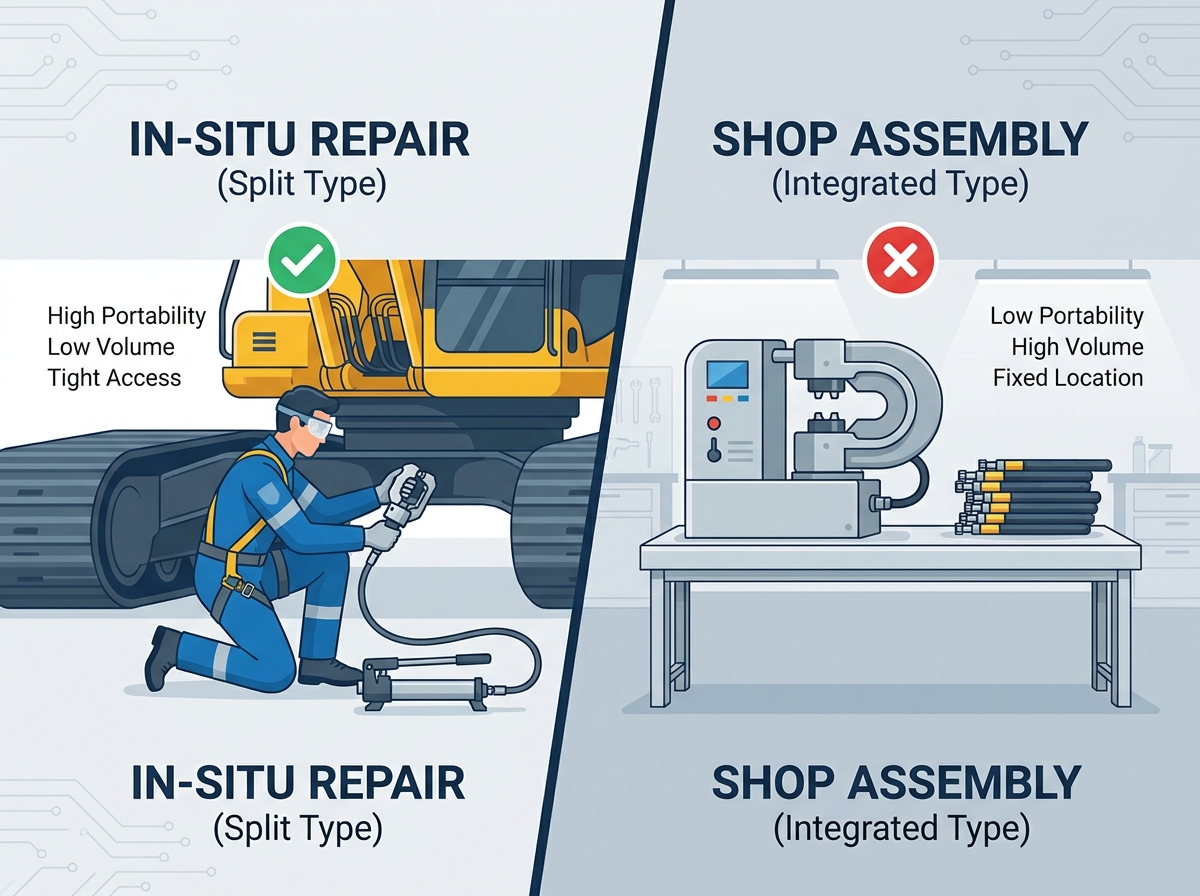
The primary advantage of a separated design is unmatched physical access. Technicians frequently encounter blown hoses in deeply recessed areas. You can maneuver a remote crimping head directly into these confined spaces. Common tight-clearance environments include heavy equipment chassis, marine bilges, and agricultural implement arms.
This design also provides major ergonomic benefits. A solo technician can safely position the lightweight head with one hand while holding the hose assembly with the other. This autonomy reduces the need to dispatch two mechanics for a single field repair.
Split systems offer incredible operational flexibility. You can pair the exact same crimping head with several different pump styles depending on your environment. Common combinations include:
Manual Hand Pumps: These require no external power. They are ideal for remote, off-grid locations like mining sites or deep forestry tracts.
Air-Over-Hydraulic Pumps: Service trucks usually carry onboard air compressors. A pneumatic pump leverages this existing air supply to drive the hydraulic fluid quickly.
Electric Pumps: Battery-powered or 110V/220V electric pumps provide rapid cycle times. They work exceptionally well for temporary field service bays or shop environments.
Building out a mobile hydraulic repair van requires careful spatial planning. Floor space inside a van is incredibly valuable. Equipping a truck with a bulky integrated machine consumes vital room. It also requires heavy-duty bench reinforcements to support the dead weight.
Split units pack away neatly. You can store the head in a standard drawer. You can bolt the pump in an unused corner. Furthermore, these separate systems generally present a lower upfront capital cost compared to automated, all-in-one mobile work centers.
Split models are not universal solutions. They fall short in high-volume production settings. The hydraulic fluid must travel back and forth through a restrictive external hose. This travel distance creates friction and inherently slows down the cycle times.
Original Equipment Manufacturer (OEM) assembly lines often require hundreds of crimps per hour. If your primary goal is rapid, continuous batch production, a split unit will severely bottleneck your output. Automated, stationary shop crimpers deliver the rapid cycle speeds required for factory assembly.
Every portable tool has an upper structural limit. Ultra-heavy-duty multi-spiral hoses push these limits. For example, 4-wire or 6-wire hoses measuring over 2 inches in diameter require enormous pressing force.
These large-bore, high-pressure assemblies demand massive die bowls and extreme frame rigidity. Portable split heads generally lack the physical steel mass necessary to handle these extreme specifications. Attempting to crimp oversized multi-spiral hoses on an undersized portable head can permanently warp the tool.
If you operate strictly inside a clean, dedicated hose shop, the split design loses its primary advantage. Managing separate components on a workbench introduces unnecessary clutter.
The connecting hydraulic line loops across the bench. It gets snagged on tools and fittings. A technician must coordinate the head, the hose, the fitting, and the remote pump controls simultaneously. In a dedicated bench environment, an all-in-one integrated unit provides a much cleaner, more stable, and intuitive workflow.
Procurement teams must carefully match the machine's maximum crimping force against expected hose specifications. We measure this force in tons. You must evaluate your maximum expected inner diameter (ID), outer diameter (OD), and wire reinforcement layers.
A portable unit generating 60 tons of force handles 1-inch, 2-wire braided hoses perfectly. However, it will fail to compress a 1.5-inch, 4-wire spiral hose. Always cross-reference your most demanding field application against the manufacturer's tonnage charts before purchasing.
Tooling quality dictates assembly safety. Over-crimping crushes the inner Teflon or rubber tube, restricting fluid flow and generating dangerous heat. Under-crimping prevents the metal teeth from biting into the wire reinforcement, leading to catastrophic high-pressure blowouts.
You should evaluate the tooling precision systematically:
Assess the quick-change mechanism. Can a technician swap all die segments simultaneously using a magnetic tool, or must they insert them one by one?
Review the micrometer dial. Ensure it allows for micro-adjustments down to a tenth of a millimeter.
Verify the base die alignment. The segments must close perfectly evenly to guarantee a uniform 360-degree compression.
The internal cylinder mechanism dramatically impacts operational speed. You must choose between single-acting and double-acting architectures based on your patience and budget.
The following comparison illustrates the core differences between the two cylinder styles.
Feature |
Single-Acting Cylinder |
Double-Acting Cylinder |
|---|---|---|
Retraction Method |
Internal heavy-duty mechanical spring |
Pressurized hydraulic fluid reversal |
Cycle Speed |
Slower. The spring takes time to push the fluid back. |
Faster. Hydraulics actively force the piston open. |
Pump Complexity |
Requires a simple 2-way valve pump. |
Requires a complex 4-way valve pump. |
Ideal Use Case |
Occasional field repairs where speed is secondary. |
Frequent mobile service calls requiring quick turnaround. |
The quick-disconnect fittings serve as the bridge between the pump and the head. They represent a critical potential failure point. Subpar couplers restrict fluid flow and cause significant pressure drops. They also leak hydraulic oil into the environment under extreme pressure. Insist on high-grade, flush-face quick couplers rated for a minimum of 10,000 PSI to ensure safe and efficient power transfer.
Field environments are inherently dirty. Connecting and disconnecting split hydraulic lines in mud, dust, or rain introduces severe contamination risks. Hydraulic pumps rely on incredibly tight internal tolerances.
A single grain of sand entering through an exposed coupler will score the pump piston. This quickly destroys the internal seals. You must enforce strict cleanliness protocols. Require your technicians to wipe down couplers before mating them. Mandate the use of heavy-duty dust caps on both the head and the pump whenever the umbilical hose is disconnected.
Operating a high-pressure hydraulic tool demands respect, especially in awkward physical positions. Pinch hazards present a serious danger. A technician holding the die bowl while triggering a remote pump risks severe hand injury if communication fails.
Proper training mitigates these risks. Technicians must learn to pre-align the hose fitting and the die segments perfectly before stepping back to engage the remote pump. They must also inspect the high-pressure umbilical hose daily. A frayed hydraulic line carrying 10,000 PSI poses a lethal injection hazard if it bursts next to an operator.
Mobile service technicians, agricultural fleet mechanics, and heavy-machinery operators gain enormous advantages from split-type architecture. We highly recommend shortlisting a split type machine when physical portability heavily outranks raw production speed. The ability to perform in-situ repairs dramatically reduces heavy equipment downtime and associated labor costs.
Before requesting vendor quotes, audit your specific operational needs. Document your most frequently replaced hose specifications, including maximum diameter and wire reinforcement ratings. Determine if your primary working environment is a cramped field site or a spacious dedicated shop. Once you define these parameters, we invite you to contact us to discuss the exact tonnage, die sets, and pump configurations required to keep your fleet running smoothly.
A: Yes, many high-capacity split models generate sufficient tonnage to press 4-wire multi-spiral hoses. However, portable units usually limit these heavy-duty applications to smaller inner diameters, typically between 1 inch and 1.5 inches. Always verify the manufacturer's maximum capacity chart, as exceeding the structural limit can permanently warp the portable die bowl.
A: You need a pump that matches the operating pressure of the crimping head. Most industrial split models require a 10,000 PSI (700 Bar) hydraulic supply. Depending on your mobility requirements, you can drive the head using a manual hand pump, an air-over-hydraulic truck pump, or an electrically driven power unit.
A: Hydraulic crimping delivers precise, repeatable 360-degree compression using engineered die sets. This guarantees a highly reliable seal. Manual swaging relies entirely on physical leverage and simple dies. Swaging produces inconsistent results and is generally considered unsafe for modern, high-pressure industrial hydraulic applications.
A: Typically, no. Die sets are proprietary to specific head designs and bowl dimensions. Even within the exact same brand, portable split heads generally utilize smaller, lighter die profiles than their larger integrated shop counterparts to keep the overall tool weight manageable for a single technician.


